CodeRabbit vs Sourcery: AI Code Review Battle (2026)
CodeRabbit vs Sourcery compared - pricing, review depth, language support, and refactoring features. Find out which AI code reviewer fits your team.
Published:
Last Updated:
Quick verdict
CodeRabbit is the more capable all-around AI code reviewer - broader language support, deeper contextual analysis, and better platform coverage at $24/user/month (Pro). Sourcery starts at $10/user/month (Pro) and excels specifically at Python refactoring with real-time IDE feedback, but its review capabilities are narrower outside of Python. If your team works primarily in Python and values automated refactoring suggestions delivered inside the editor, Sourcery offers genuine value that CodeRabbit does not replicate. For multi-language teams, enterprise environments, or anyone prioritizing contextual bug detection across an entire codebase, CodeRabbit is the stronger choice.
The competitive landscape for AI code review is crowded in 2026, but CodeRabbit and Sourcery occupy distinct niches. CodeRabbit competes head-to-head with tools like GitHub Copilot code review and Codium PR-Agent on PR-level analysis. Sourcery competes more with IDE-based tools and Python-specific linters. Understanding where each tool excels - and where it falls short - is what this comparison covers in detail.
At-a-glance comparison
| Feature | CodeRabbit | Sourcery |
|---|---|---|
| Primary strength | Contextual multi-language PR review | Python refactoring and code quality |
| Review approach | PR-level with cross-file context | File-level with pattern matching |
| Free tier | Yes - unlimited public repos, full features | Yes - limited features |
| Pro pricing | $24/user/month | $10/user/month |
| Enterprise pricing | $30/user/month | Contact sales |
| GitHub support | Yes | Yes |
| GitLab support | Yes | Yes |
| Bitbucket support | Yes | No |
| Azure DevOps support | Yes | No |
| Python analysis depth | Strong | Excellent |
| JavaScript/TypeScript | Excellent | Good |
| Go, Java, Rust, C++ | Strong | Limited or none |
| Total languages | All major languages | Python, JS, TS + limited others |
| Cross-file context | Yes - reads callers and consumers | Limited - primarily file-scoped |
| Natural language config | Yes - plain English instructions | No - rule-based configuration |
| One-click fix commits | Yes | Yes - refactoring-focused |
| IDE extension | No | Yes (VS Code, PyCharm) |
| Code quality metrics | Via integrations | Built-in quality score |
| Self-hosted option | Yes (Enterprise) | No |
| SOC 2 compliance | Yes - Type II | Not publicly published |
| Learning from feedback | Yes - adapts over time | No - static rule engine |
| Project management integration | Jira, Linear | No |
What is CodeRabbit?
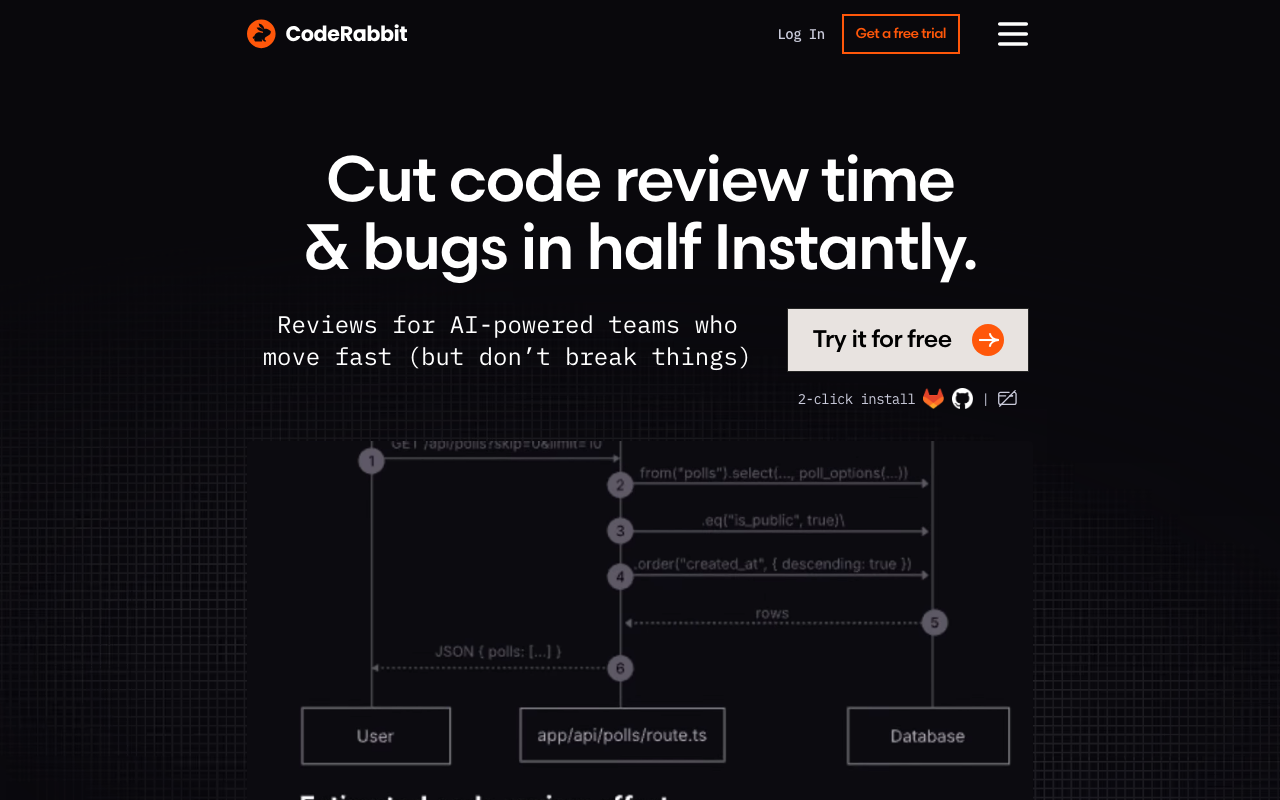
CodeRabbit is an AI-powered code review platform that operates at the pull request level. When a developer opens or updates a PR on GitHub, GitLab, Bitbucket, or Azure DevOps, CodeRabbit automatically analyzes the diff, reads the broader codebase for context, and posts detailed line-by-line review comments. It identifies bugs, security vulnerabilities, performance bottlenecks, style violations, and architectural concerns - then suggests fixes that developers can commit with a single click.
What makes CodeRabbit distinctive is its contextual awareness. It does not treat each file change in isolation. When you modify a database query function, CodeRabbit traces the callers of that function, checks how the return value is consumed downstream, and flags issues that only become visible when you understand the cross-file relationships. A change to an API response shape triggers warnings about frontend consumers in a monorepo. A modified validation function prompts CodeRabbit to check every location where that function is called.
Configuration happens in natural language. Instead of enabling and disabling individual lint rules, teams write plain English instructions in a .coderabbit.yaml file:
# .coderabbit.yaml
reviews:
  instructions:
    - "Enforce that all API responses include a correlation ID"
    - "Flag console.log statements in production code"
    - "Require error handling for all database operations"
    - "Suggest pagination for any query that could return unbounded results"
These instructions are version-controlled, visible to the whole team, and self-documenting. New engineers read the configuration file and immediately understand the team’s coding standards without parsing through hundreds of lint rule names.
CodeRabbit also learns from interaction. When developers accept, dismiss, or ask follow-up questions on its comments, CodeRabbit adjusts its sensitivity and focus. After a few weeks of active use, it calibrates to a team’s specific preferences - flagging more of what matters and less of what does not. This adaptive behavior is something static rule engines cannot replicate.
CodeRabbit offers three pricing tiers: a free plan with full features on unlimited public repositories, a Pro plan at $24/user/month for private repositories, and an Enterprise plan at $30/user/month with self-hosted deployment, SSO, and compliance features.
What is Sourcery?
Sourcery is an AI code quality tool that started as a Python refactoring engine and expanded into broader code review. Its roots in Python are evident: Sourcery’s deepest and most useful analysis happens in Python codebases, where it identifies complex refactoring opportunities that other tools miss entirely. It has since added support for JavaScript, TypeScript, and other languages, but the depth of analysis drops noticeably outside its core Python domain.
Sourcery’s refactoring engine is genuinely best-in-class for Python. It recognizes patterns like nested conditionals that can be simplified, for loops that should be list comprehensions, if/elif chains that would be cleaner as dictionary dispatch, and classes that would benefit from conversion to dataclasses. These are not trivial suggestions - they represent the kind of structural improvements that experienced Python developers make during code review, automated and applied consistently across every PR.
The IDE integration is a key differentiator. Sourcery offers extensions for VS Code and PyCharm that provide real-time refactoring suggestions as developers write code. Rather than waiting for a PR to be opened, Sourcery highlights improvement opportunities inline while you type, suggests refactored versions, and can auto-apply fixes. This immediate feedback loop helps developers write better code from the start rather than catching issues after the fact.
Sourcery also provides a code quality score that gives teams a quantitative measure of their codebase health. Each file and each PR receives a quality rating based on complexity, readability, and adherence to best practices. This scoring system helps teams track improvements over time and set measurable quality targets.
Sourcery offers a free tier with limited features, a Pro plan at $10/user/month that unlocks private repo support and custom coding guidelines, and a Team plan at $24/user/month that adds security scanning, analytics, and higher rate limits.
How does CodeRabbit work?
CodeRabbit integrates directly with your Git platform through a simple installation flow. You add CodeRabbit to your GitHub organization, GitLab group, Bitbucket workspace, or Azure DevOps project, select which repositories to enable, and configure your preferences. From that point forward, every PR triggers an automated review.
The review process follows a multi-step pipeline. First, CodeRabbit ingests the diff and identifies which files changed and how. Second, it reads the broader repository context - related files, function definitions, imports, callers, and consumers of the modified code. Third, it applies its AI analysis engine, which combines large language model reasoning with static analysis rules, to identify issues across multiple categories: correctness, security, performance, maintainability, and style. Fourth, it posts its findings as inline comments on the PR, each with a clear explanation and a suggested fix.
The one-click fix workflow is particularly efficient. When CodeRabbit suggests a change, developers can accept the suggestion and commit it directly from the PR interface without switching to their IDE, making the change manually, and pushing a new commit. For simple fixes - adding a null check, correcting an off-by-one error, fixing a type annotation - this saves meaningful time across a team.
CodeRabbit also supports interactive review. Developers can reply to CodeRabbit’s comments with questions or disagreements, and CodeRabbit responds with additional context or revised analysis. This conversational approach makes the review feel more like working with a knowledgeable colleague than reading static lint output.
Is CodeRabbit legit?
Yes, CodeRabbit is a legitimate and well-established AI code review tool. It is used by thousands of development teams across startups, mid-size companies, and enterprises. CodeRabbit is SOC 2 Type II compliant, which means its security practices have been independently audited. The tool never stores your code or uses it for model training - code is analyzed in memory and discarded after review.
For teams concerned about data security, CodeRabbit offers a self-hosted enterprise deployment option where the entire system runs within your own infrastructure. This is critical for organizations in regulated industries - finance, healthcare, government, and defense - where code cannot leave the corporate network.
The free tier is genuinely generous. Public repositories get unlimited access to the same AI model, the same analysis depth, and the same features as paid plans. Open source maintainers use CodeRabbit as a full-featured reviewer at zero cost, which has helped build community trust and a large user base that validates the tool’s capabilities.
Can CodeRabbit review the entire codebase?
CodeRabbit is designed as a PR-level reviewer, not a full-codebase scanner. It triggers on pull requests and analyzes changes in the context of the broader repository. This distinction matters: CodeRabbit does not run a scheduled scan across every file in your codebase the way a traditional static analysis tool like SonarQube would.
However, CodeRabbit’s analysis is not limited to the diff alone. When reviewing a PR, CodeRabbit reads surrounding files to understand context. It follows function calls, checks how modified code is consumed elsewhere, and identifies issues that span multiple files. In practice, a single PR review may involve CodeRabbit analyzing dozens of files beyond the ones that changed, giving it a working understanding of the relevant portions of your codebase.
For initial onboarding, CodeRabbit can also perform a repository-level context build that helps it understand your project’s architecture, conventions, and patterns. This context persists across reviews, so CodeRabbit’s analysis gets more accurate over time as it processes more PRs and builds a deeper understanding of how your codebase is structured.
If you need full-codebase scanning for compliance or audit purposes, pair CodeRabbit with a dedicated static analysis tool like SonarQube, Semgrep, or DeepSource. CodeRabbit excels at catching issues in the flow of development (at the PR stage), while static analyzers excel at comprehensive baseline scans.
Feature-by-feature comparison
Detection and analysis capabilities
CodeRabbit’s contextual understanding is its defining advantage. When you open a PR that modifies a database query function, CodeRabbit does not just look at the changed lines. It reads the callers of that function, checks how the return value is used downstream, and flags issues that only become visible in context. A change to an API response shape triggers warnings about frontend consumers in a monorepo. A modified validation function prompts CodeRabbit to check all the places that function is called.
Sourcery’s analysis approach is fundamentally different - localized and pattern-driven. It analyzes the diff and the immediate file context, then applies its refactoring rule engine to suggest improvements. For Python, these suggestions are often excellent:
# Sourcery flags this pattern...
result = []
for item in items:
    if item.is_active:
        result.append(item.name)

# ...and suggests this idiomatic alternative
result = [item.name for item in items if item.is_active]
# Sourcery also catches this...
if condition:
return True
else:
return False
# ...and suggests this
return conditionThese refactoring suggestions are genuinely useful and often produce cleaner, more Pythonic code. But they are pattern-based transformations, not contextual analysis. Sourcery will not catch a race condition between two async functions or flag a missing null check that matters because of how a value is used three files away.
The detection gap widens outside of Python. CodeRabbit maintains consistent analysis quality across all major languages - it catches bugs, security issues, and architectural problems in Go, Java, Rust, C++, and TypeScript with the same depth it brings to Python. Sourcery’s analysis in JavaScript and TypeScript is functional but noticeably thinner than its Python coverage, and support for other languages is minimal.
In practical terms, CodeRabbit is better at catching the bugs that cause production incidents - null pointer dereferences that only manifest in certain code paths, race conditions in concurrent code, API contract violations that break downstream consumers. Sourcery is better at catching the code quality issues that make maintenance harder - overly complex functions, non-idiomatic patterns, duplicated logic, and poor structure.
Language support
CodeRabbit takes a language-agnostic approach. It applies general software engineering principles - correctness, security, performance, readability - across all languages equally. Whether your codebase is Python, TypeScript, Go, Java, Rust, C++, C#, PHP, Ruby, Kotlin, Swift, or a combination, CodeRabbit reviews it all with consistent depth. This breadth is essential for modern development teams that rarely work in a single language.
Sourcery takes a language-specialized approach, with Python as the clear priority. In Python, Sourcery has hundreds of specific refactoring rules that CodeRabbit does not match - it knows every Pythonic idiom, every standard library optimization, every dataclass pattern. JavaScript and TypeScript support exists but with fewer rules and shallower analysis. Go, Java, Rust, and C++ support ranges from very limited to nonexistent.
For polyglot teams - which is most teams in 2026 - CodeRabbit’s breadth is more practical. Your frontend is TypeScript, your backend is Go or Python, your infrastructure is Terraform, and your mobile app is Kotlin or Swift. You need one tool that reviews all of it competently rather than one tool that reviews Python brilliantly and everything else poorly.
If your team is 80%+ Python, Sourcery’s depth becomes a compelling argument. The refactoring suggestions alone can measurably improve code quality over time, and no other tool matches Sourcery’s understanding of Python-specific patterns. But if Python is one of several languages in your stack, CodeRabbit’s consistent quality across the board is the safer investment.
Platform and CI/CD integration
CodeRabbit supports the broadest set of Git platforms in the AI code review category. GitHub, GitLab, Bitbucket, and Azure DevOps are all fully supported with native PR decoration, inline comments, and status checks. This coverage is critical for enterprise teams that standardize on platforms other than GitHub.
Sourcery supports GitHub and GitLab but lacks Bitbucket and Azure DevOps integration. For many enterprise organizations that run on Azure DevOps or Bitbucket Server, Sourcery is simply not an option - the platform decision eliminates it from consideration regardless of its analysis quality.
CodeRabbit also integrates with project management tools. Jira and Linear integrations allow CodeRabbit to cross-reference PR implementations against ticket requirements, providing context-aware reviews that validate whether a PR actually addresses the stated objective. Sourcery does not offer project management integrations, focusing purely on code quality metrics.
For CI/CD pipelines, both tools integrate through their respective Git platform webhooks. CodeRabbit triggers automatically on PR events and requires no CI configuration changes. Sourcery similarly operates through Git webhooks but also offers a CLI that can run in CI pipelines for additional flexibility.
Security analysis
CodeRabbit identifies security issues as part of its general review process. It catches common vulnerabilities - SQL injection, XSS, insecure deserialization, hardcoded credentials, missing authentication checks, and insecure cryptographic usage - across all supported languages. The contextual analysis is particularly valuable for security: CodeRabbit can trace user input through multiple functions and flag locations where unsanitized data reaches a sensitive sink.
Sourcery’s security coverage is more limited. Its primary focus is code quality and refactoring rather than security-specific analysis. While it catches some security anti-patterns in Python (like using eval() on untrusted input or hardcoded secrets), it does not provide the depth of security analysis that CodeRabbit or dedicated security tools like Semgrep or Snyk Code deliver.
For teams that need comprehensive security scanning, neither CodeRabbit nor Sourcery should be the sole security tool. Both are better complemented by a dedicated SAST solution. But between the two, CodeRabbit covers significantly more security ground.
Developer experience and workflow
Sourcery’s IDE integration is its strongest workflow advantage. The VS Code and PyCharm extensions provide real-time feedback as developers write code. Refactoring suggestions appear inline, highlighted with clear explanations of why the change improves the code. Developers can accept suggestions with a keyboard shortcut and see the improved code immediately. This tight feedback loop catches issues before they ever reach a PR.
CodeRabbit is intentionally PR-focused and does not offer an IDE extension. The design philosophy is that meaningful code review requires understanding changes in the context of the broader codebase, which is only possible at the PR stage. IDE-level analysis can only see the file you are editing, not the system-wide impact of your changes.
Both approaches have merit. Sourcery’s IDE feedback prevents issues from reaching PRs in the first place, reducing review cycles. CodeRabbit’s PR-level analysis catches higher-impact issues that file-level analysis fundamentally cannot detect. The ideal workflow arguably uses both: Sourcery for immediate feedback while coding, CodeRabbit for contextual review when the code is ready for merge.
CodeRabbit’s interactive review experience is unique. Developers can reply to CodeRabbit’s comments, ask clarifying questions, request alternative approaches, or explain why a flagged pattern is intentional. CodeRabbit responds conversationally, adjusting its analysis based on the dialogue. Sourcery’s review output is more static - it presents findings and suggestions, but there is no conversational back-and-forth.
Customization and configuration
CodeRabbit’s natural language configuration is unmatched in the AI review space. You describe your team’s coding standards, conventions, and priorities in plain English, and CodeRabbit enforces them. This approach has two major advantages: it is accessible to developers who do not want to learn a rule DSL, and it can express arbitrary conventions that no predefined rule set could cover.
Examples of natural language instructions that work in CodeRabbit:
reviews:
  instructions:
    - "All API endpoints must validate request body against a schema"
    - "Database queries should use parameterized statements, never string concatenation"
    - "React components must have PropTypes or TypeScript types defined"
    - "Error messages should never expose internal implementation details"
    - "Functions longer than 50 lines should be flagged for refactoring"
Sourcery uses a rule-based configuration system. You enable or disable specific refactoring rules, set quality thresholds, configure which directories to analyze, and adjust the sensitivity of various checks. The configuration is more traditional and predictable - you know exactly which rules are active and what they check for - but it is less flexible for encoding team-specific conventions that do not map to predefined rules.
CodeRabbit’s adaptive learning adds another layer of customization. Over time, it learns which types of comments developers accept and which they dismiss, adjusting its sensitivity accordingly. After a few weeks of active use, CodeRabbit effectively builds a custom review profile for each team. Sourcery’s rule engine is more static - it applies the same rules consistently regardless of team feedback, which provides predictability but no adaptation.
Pricing comparison
| Plan | CodeRabbit | Sourcery |
|---|---|---|
| Free | Unlimited public repos, full features | Limited features, basic refactoring |
| Pro | $24/user/month | $10/user/month |
| Team | N/A | $24/user/month |
| Enterprise | $30/user/month | Contact sales |
| Annual discount | Available | Available |
| Billing model | Per seat | Per seat |
| Self-hosted | Enterprise plan only | Not available |
For a team of 10 engineers, the annual cost comparison:
| Team size | CodeRabbit Pro | Sourcery Pro | Sourcery Team |
|---|---|---|---|
| 5 developers | $1,440/year | $600/year | $1,440/year |
| 10 developers | $2,880/year | $1,200/year | $2,880/year |
| 25 developers | $7,200/year | $3,000/year | $7,200/year |
| 50 developers | $14,400/year | $6,000/year | $14,400/year |
Sourcery’s Pro tier is now the more affordable option at $10/user/month versus CodeRabbit’s $24/user/month. However, Sourcery’s Team plan at $24/user/month matches CodeRabbit Pro pricing exactly. The key distinction is what each tool offers at each tier - CodeRabbit Pro provides broader language support, deeper contextual analysis, and more platform integrations, while Sourcery Team adds security scanning and analytics that CodeRabbit Pro does not include.
CodeRabbit’s free tier is more generous. Public repositories get unlimited, unrestricted access - the same AI model, the same features, the same analysis quality as paid plans. Open source maintainers get a world-class AI reviewer at zero cost. Sourcery offers a free tier as well, but with significant feature restrictions that limit its usefulness for serious projects.
The Enterprise tier comparison is harder to evaluate directly since Sourcery does not publish enterprise pricing. CodeRabbit’s Enterprise plan at $30/user/month adds self-hosted deployment, SSO/SAML, audit logs, and priority support.
Both tools offer free trials that let teams evaluate before committing. CodeRabbit’s trial includes the full Pro feature set on private repositories. This evaluation period is worth using before making a purchasing decision - the right tool depends heavily on your specific team’s language mix, workflow preferences, and platform requirements.
Use-case comparison
| Scenario | Better choice | Why |
|---|---|---|
| Polyglot team (3+ languages) | CodeRabbit | Consistent quality across all languages |
| Python-only team | Sourcery | Deepest Python refactoring rules |
| Enterprise (100+ devs) | CodeRabbit | Self-hosted, SOC 2, Azure DevOps support |
| Startup (5-10 devs, budget-conscious) | CodeRabbit | Lower per-user cost with broader coverage |
| Open source project | CodeRabbit | Full-featured free tier for public repos |
| Data science / ML team | Sourcery | Python focus, notebook-friendly refactoring |
| Team using Azure DevOps | CodeRabbit | Only option - Sourcery lacks Azure DevOps |
| Team using Bitbucket | CodeRabbit | Only option - Sourcery lacks Bitbucket |
| IDE-first workflow preference | Sourcery | Real-time VS Code/PyCharm extensions |
| PR-first workflow preference | CodeRabbit | Deeper PR-level contextual analysis |
| Regulated industry (finance, healthcare) | CodeRabbit | SOC 2, self-hosted, compliance features |
| Team wanting both IDE + PR review | Both | Sourcery in IDE, CodeRabbit on PRs |
Security and compliance considerations
CodeRabbit publishes SOC 2 Type II compliance and offers self-hosted deployment for enterprise customers. Your code is analyzed in memory and discarded - never stored, never used for training. For regulated industries (healthcare, finance, government), CodeRabbit provides the compliance documentation and deployment options required for procurement approval.
The self-hosted deployment option is significant for enterprise buyers. Many large organizations have strict data residency requirements that prohibit sending source code to third-party cloud services. CodeRabbit’s Enterprise plan allows the entire review infrastructure to run within the customer’s own cloud environment or on-premises data center, keeping code inside the corporate boundary at all times.
Sourcery does not publicly advertise SOC 2 compliance as of early 2026. It also does not offer a self-hosted deployment option. For teams with strict data residency requirements or procurement processes that require SOC 2 attestation, this may be a disqualifying limitation. Teams in regulated industries should verify Sourcery’s current compliance status directly with their sales team before evaluating further.
Both tools use encrypted connections for all data in transit, and neither tool uses customer code for model training. The key differentiator is CodeRabbit’s independently audited compliance posture and its self-hosted option for organizations that need the highest level of data control.
When to choose CodeRabbit
Choose CodeRabbit if:
- Your team works across multiple programming languages. CodeRabbit provides consistent review quality in Python, TypeScript, Go, Java, Rust, C++, and every other major language. You do not need separate tools or accept diminished analysis for non-Python code.
- You need deep contextual review. CodeRabbit reads callers, consumers, and related files to understand the system-wide impact of every change. This catches bugs that file-level analysis fundamentally cannot detect.
- Your platform is Azure DevOps or Bitbucket. Sourcery does not support either. If your organization uses these platforms, CodeRabbit is the only option.
- Compliance and enterprise features matter. SOC 2 Type II, self-hosted deployment, SSO/SAML, and audit logs are available on the Enterprise plan.
- Natural language configuration appeals to your team. Writing review rules in plain English is faster, more flexible, and more accessible than managing rule configurations.
- Budget is a consideration. At $24/user/month, CodeRabbit Pro is actually $5/user/month cheaper than Sourcery Pro while offering broader capabilities.
When to choose Sourcery
Choose Sourcery if:
- Your team is primarily Python-focused (80%+ of codebase). Sourcery’s Python refactoring engine has no equal. It catches idiomatic improvements, structural refactoring opportunities, and Python-specific anti-patterns that no other tool matches.
- IDE-integrated real-time feedback is important. Sourcery’s VS Code and PyCharm extensions provide instant refactoring suggestions as you write code, catching issues before they reach a PR.
- Automated refactoring suggestions are more valuable than bug detection. If your codebase has more code quality debt than correctness issues, Sourcery’s refactoring focus delivers targeted value.
- Your team uses GitHub or GitLab exclusively. Sourcery covers both platforms fully, and the Bitbucket/Azure DevOps limitation does not apply.
- You want a built-in code quality score. Sourcery’s quantitative quality metrics give teams a measurable benchmark for tracking improvement over time.
When to use both
The smartest approach for Python-heavy teams with budget flexibility is to use both tools together. Sourcery in the IDE for real-time refactoring as developers write code, and CodeRabbit on PRs for contextual review that catches bugs, security issues, and cross-file problems.
This combination provides defense in depth across the entire development workflow:
- While coding: Sourcery highlights refactoring opportunities, suggests idiomatic patterns, and improves code structure in real time.
- At PR time: CodeRabbit analyzes the changes in context, catches bugs that span multiple files, identifies security issues, and validates against team conventions.
- After merge: Both tools contribute to measurable code quality improvement over time.
The combined cost of $53/user/month ($24 CodeRabbit Pro + $29 Sourcery Pro) is meaningful but reasonable for teams that treat code quality as a priority. A single production bug prevented pays for months of tooling costs.
If budget forces a single choice, CodeRabbit is the safer pick for most teams due to its broader language support, deeper contextual analysis, platform coverage, and lower per-user cost. Sourcery earns the nod only for teams where Python dominates the codebase and IDE-level refactoring feedback is a high-priority workflow requirement.
Bottom line
CodeRabbit and Sourcery are fundamentally different tools that happen to overlap in the “AI code review” category. CodeRabbit is a contextual PR reviewer that works across all languages and platforms, catching the kinds of bugs and issues that cause production incidents. Sourcery is a code quality tool with an exceptional Python refactoring engine and real-time IDE feedback.
For most teams, CodeRabbit is the better standalone investment. It costs less per user ($24 vs $29/month), supports more languages, integrates with more platforms, offers self-hosted enterprise deployment, and provides deeper contextual analysis. The natural language configuration and adaptive learning make it increasingly valuable over time.
For Python-heavy teams, Sourcery’s refactoring engine is genuinely best-in-class. No other tool understands Python idioms as deeply or suggests structural improvements as accurately. The IDE extensions provide a feedback loop that CodeRabbit’s PR-focused approach cannot match.
The strongest overall strategy for Python teams is using both: Sourcery for real-time IDE feedback and CodeRabbit for contextual PR review. You get the best of both worlds - clean, idiomatic Python code and thorough, contextual review before merge. But if you are choosing one tool, CodeRabbit is the one that catches the bugs that matter across your entire stack.
Further Reading
- Will AI Replace Code Reviewers? What the Data Actually Shows
- Best AI Code Review Tools in 2026 - Expert Picks
- Best AI Code Review Tools for Pull Requests in 2026
- Best AI Tools for Developers in 2026 - Code Review, Generation, and Testing
- Best Code Review Tools for Python in 2026 - Linters, SAST, and AI
 Gitar
GitarComments are not enough
Gitar applies the fix, validates it in CI, and clears the queue.
See it on your repo Read our independent Gitar reviewFrequently Asked Questions
Is CodeRabbit legit?
Yes, CodeRabbit is a legitimate and widely adopted AI code review tool used by thousands of development teams. It is SOC 2 Type II compliant, never stores or trains on your code, and offers self-hosted deployment for enterprise customers. CodeRabbit integrates with GitHub, GitLab, Bitbucket, and Azure DevOps, and provides a generous free tier with unlimited access on public repositories. Its natural language configuration and contextual PR review capabilities make it one of the most capable AI code reviewers available in 2026.
Can CodeRabbit review the entire codebase?
CodeRabbit primarily operates at the pull request level, reviewing diffs and changed files in context. However, it does not limit itself to just the changed lines. CodeRabbit reads the surrounding codebase to understand cross-file dependencies, function callers, downstream consumers, and architectural patterns. For initial onboarding, CodeRabbit can also perform a full repository scan to build context. So while it is triggered by PRs rather than scanning the entire codebase on demand, its contextual analysis effectively considers the broader codebase when reviewing changes.
How does CodeRabbit work?
CodeRabbit works by integrating with your Git platform (GitHub, GitLab, Bitbucket, or Azure DevOps) and automatically reviewing every pull request. When a PR is opened or updated, CodeRabbit analyzes the diff, reads the surrounding codebase for context, and posts line-by-line review comments identifying bugs, security issues, performance problems, and style violations. It suggests fixes that can be committed with one click. Teams configure review behavior using natural language instructions in a .coderabbit.yaml file, and CodeRabbit learns from developer feedback over time to calibrate its sensitivity.
Is Sourcery good for Python?
Yes, Sourcery is excellent for Python development. It started as a Python-focused refactoring engine and has the deepest Python-specific analysis of any AI code review tool. Sourcery identifies complex refactoring opportunities like converting loops to list comprehensions, simplifying nested conditionals, replacing if/elif chains with dictionary dispatch, and suggesting dataclass conversions. Its IDE extensions for VS Code and PyCharm provide real-time Python refactoring suggestions as you write code, which is a workflow that no other AI reviewer matches.
Can I use CodeRabbit and Sourcery together?
Yes, using CodeRabbit and Sourcery together is a viable strategy, especially for Python-heavy teams. The recommended setup is Sourcery in the IDE (VS Code or PyCharm) for real-time refactoring suggestions while writing code, and CodeRabbit on pull requests for contextual review that catches bugs, security issues, and cross-file problems. The combined cost is approximately $34/user/month ($24 CodeRabbit Pro + $10 Sourcery Pro), which is reasonable for teams that want defense in depth across the entire development workflow.
What is the difference between CodeRabbit and Sourcery?
The core difference is scope and approach. CodeRabbit is a multi-language PR reviewer that analyzes diffs in the context of your broader codebase, catching bugs, security issues, and architectural problems across all major programming languages. Sourcery started as a Python refactoring engine and expanded into broader code review, but its deepest analysis remains Python-focused. CodeRabbit supports more platforms (GitHub, GitLab, Bitbucket, Azure DevOps vs GitHub and GitLab only), offers natural language configuration, and provides self-hosted enterprise deployment. Sourcery offers IDE extensions and real-time feedback that CodeRabbit does not.
How much does Sourcery cost per month?
Sourcery Pro costs $10/user/month for private repo support and custom coding guidelines. The Team plan at $24/user/month adds security scanning, analytics, and higher rate limits. A limited free tier is also available. By comparison, CodeRabbit Pro costs $24/user/month, matching Sourcery's Team plan pricing while offering broader language support and deeper contextual analysis.
Does CodeRabbit have an IDE extension?
CodeRabbit does not offer an IDE extension for real-time feedback while coding. It is intentionally PR-focused, operating at the pull request stage where it can analyze changes in the context of the broader codebase. Sourcery, by contrast, offers VS Code and PyCharm extensions with real-time refactoring suggestions. Teams wanting both IDE feedback and deep PR review can use Sourcery in the IDE alongside CodeRabbit on pull requests.
Is Sourcery only for Python?
No, Sourcery has expanded beyond Python to support JavaScript and TypeScript, along with limited support for other languages. However, Python remains its core strength with the deepest analysis, the most refactoring rules, and the best IDE integration. Outside of Python, Sourcery's review capabilities are noticeably thinner. For teams working across multiple languages, CodeRabbit provides more consistent analysis quality across the full stack.
What is the best AI code review tool for Python?
For Python-specific refactoring and IDE feedback, Sourcery is the best choice. It identifies complex refactoring opportunities like converting loops to list comprehensions, simplifying nested conditionals, and suggesting dataclass conversions. For broader PR-level review that catches bugs, security issues, and cross-file problems in Python alongside other languages, CodeRabbit is the stronger option. The ideal setup for Python-heavy teams is using both together - Sourcery in the IDE and CodeRabbit on PRs.
Does CodeRabbit support Bitbucket and Azure DevOps?
Yes, CodeRabbit fully supports Bitbucket and Azure DevOps in addition to GitHub and GitLab. This is a significant differentiator, as Sourcery only supports GitHub and GitLab. For enterprise teams using Azure DevOps or Bitbucket Server, CodeRabbit is the only option between the two tools. All four platforms receive full feature parity including line-by-line PR comments, fix suggestions, and natural language configuration.
Is CodeRabbit SOC 2 compliant?
Yes, CodeRabbit is SOC 2 Type II compliant, meaning its security practices have been independently audited. Your code is analyzed in memory and discarded after the review - it is never stored or used for model training. CodeRabbit also offers a self-hosted enterprise deployment option for regulated industries. Sourcery does not publicly advertise SOC 2 compliance as of early 2026, which may be a factor for enterprise procurement decisions.
Explore More
Tool Reviews
 CodeRabbit Review
 Sourcery Review
Free Newsletter
Stay ahead with AI dev tools
Weekly insights on AI code review, static analysis, and developer productivity. No spam, unsubscribe anytime.
Join developers getting weekly AI tool insights.
Related Articles
CodeRabbit vs Claude Code: Honest 2026 Comparison
CodeRabbit vs Claude Code compared on review depth, real cost per seat, latency, security and documented failure modes - sourced evidence, not vendor claims.
August 19, 2026
comparisonHow to Make Code Reviews Faster: 12 Proven Tactics
How to make code reviews faster: decompose PR cycle time, cut round-trips, right-size PRs, and set review SLAs - with sourced targets from Google and SmartBear.
August 19, 2026
comparisonGitar vs CodeRabbit: Fix-and-Validate or Best-in-Class Comments?
Gitar vs CodeRabbit compared on review model, CI ownership, migrations, pricing, platform support, and evaluation risk. An honest breakdown of which one fits your team.
August 12, 2026