10 Best Veracode Alternatives for AppSec
Veracode too expensive? Compare the 10 best Veracode alternatives for SAST, SCA, and AppSec with real pricing, feature comparisons, and migration guidance.
Published:
Last Updated:
Why teams look beyond Veracode
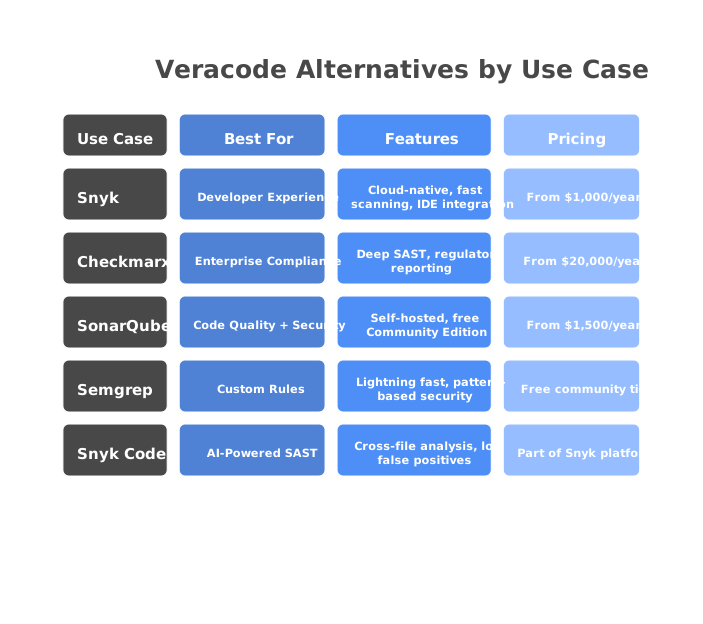
Veracode is a legitimate powerhouse in application security testing. With 11 consecutive years as a Gartner Magic Quadrant Leader for Application Security Testing, comprehensive coverage across SAST, DAST, SCA, and container security, and compliance reporting that auditors actually accept, Veracode has earned its reputation as a go-to platform for enterprise AppSec programs. But there are real, well-documented reasons teams start evaluating alternatives.
The pricing is the biggest barrier. Veracode SAST starts at approximately $15,000/year, SCA at $12,000/year, and the full enterprise platform easily exceeds $100,000 annually. For context, that means a 50-developer team running Veracode SAST alone pays roughly $300 per developer per year before adding SCA, DAST, or container scanning. Competitors like Semgrep offer comparable SAST coverage for $35/contributor/month (approximately $420/year), and Aikido Security bundles SAST, SCA, DAST, and container scanning for $300/month for 10 users. The price gap is significant, and for startups, mid-market companies, and even enterprise teams with limited AppSec budgets, that is a hard pill to swallow.
Binary analysis creates friction in modern CI/CD workflows. Veracode’s distinctive approach of scanning compiled binaries rather than source code means your application must be fully built before it can be scanned. This adds meaningful time and complexity to CI/CD pipelines that source-code SAST tools like Semgrep or Snyk avoid entirely. It also makes pinpointing exact source lines harder, which frustrates developers trying to fix flagged issues. In a world where teams expect sub-minute feedback on pull requests, waiting for a full build-then-scan cycle creates drag that slows down delivery velocity.
The developer experience feels enterprise-grade in the wrong ways. Full platform scans can take hours for large applications. The interface is oriented toward security teams rather than the developers who actually remediate vulnerabilities. Setup and policy configuration are non-trivial, often requiring weeks of professional services or internal security engineering time to tune effectively. Teams accustomed to modern developer-first tools like Snyk or Semgrep - where you can go from zero to scanning in under 10 minutes - find Veracode’s onboarding curve steep and frustrating.
No free tier for scanning. The only free component is Security Labs Community Edition for developer training. There is no way to evaluate Veracode’s actual scanning capabilities without engaging sales, which eliminates the “try before you buy” workflow that most modern tools support. This matters because teams increasingly want to evaluate tools on their actual codebase before committing to a contract.
False positive management requires dedicated effort. While Veracode’s detection accuracy is generally strong, the volume of findings on large applications can overwhelm teams without a dedicated security champion. Tuning policies, suppressing false positives, and managing remediation workflows across multiple applications requires ongoing investment that smaller teams may not have bandwidth for.
None of this means Veracode is a bad tool. For large enterprises with diverse application portfolios and serious compliance requirements, it remains one of the strongest options available. But if any of the above pain points resonate, the alternatives below deserve serious consideration.
Quick comparison table
| Tool | Rating | Free Tier | SAST | SCA | DAST | Languages | Starting Price |
|---|---|---|---|---|---|---|---|
| Snyk Code | 4.5 | Yes | Yes | Yes | No | 19+ | $25/dev/mo |
| Semgrep | 4.6 | Yes | Yes | Yes | No | 30+ | $35/contributor/mo |
| Checkmarx | 4.3 | No | Yes | Yes | Yes | 40+ | ~$59K/year |
| Fortify | 4.3 | No | Yes | Limited | Yes | 33+ | Contact sales |
| Aikido Security | 4.0 | Yes | Yes | Yes | Yes | 25+ | $300/mo (10 users) |
| Coverity | 4.3 | Free for OSS | Yes | No | No | 22+ | $500/dev/year |
| SonarQube | 4.5 | Yes | Yes | Yes (Enterprise) | No | 35+ | Free / $2,500/yr |
| Corgea | 3.9 | Yes | Yes | Yes | No | 25+ | $39/dev/mo |
| HackerOne Code | 4.5 | No | Yes | Yes | No | Varies | ~$15K/year |
| Veracode | 4.4 | No | Yes | Yes | Yes | 30+ | ~$15K/year |
Pricing comparison: what you will actually pay
One of the biggest reasons teams leave Veracode is cost. Here is a realistic pricing breakdown across team sizes to help you compare.
| Tool | 10 Developers | 25 Developers | 50 Developers | 100 Developers |
|---|---|---|---|---|
| Veracode (SAST only) | ~$15,000/yr | ~$25,000/yr | ~$50,000/yr | ~$90,000/yr |
| Veracode (Full Platform) | ~$40,000/yr | ~$65,000/yr | ~$100,000/yr | ~$200,000+/yr |
| Snyk Code (Team) | $3,000/yr | $7,500/yr | $15,000/yr | $67,000-$90,000/yr |
| Semgrep (Team) | $4,200/yr | $10,500/yr | $21,000/yr | $42,000/yr |
| Checkmarx One | ~$59,000/yr | ~$100,000/yr | ~$200,000/yr | ~$500,000/yr |
| Aikido Security | $3,600/yr | ~$7,200/yr | ~$14,400/yr | Custom |
| SonarQube Developer | $2,500/yr | $2,500/yr | $2,500/yr | $10,000/yr |
| Corgea (Growth) | $4,680/yr | $11,700/yr | $23,400/yr | $46,800/yr |
| SonarQube + Semgrep OSS | $2,500/yr | $2,500/yr | $2,500/yr | $10,000/yr |
Note: All pricing is approximate and based on publicly available information and industry reports. Actual pricing varies by contract terms, scan volume, and negotiation. Veracode, Checkmarx, and Fortify use quote-based pricing that can vary significantly.
1. Snyk Code - Best developer-first alternative
Rating: 4.5 | Free tier available | $25/developer/month (Team)
Snyk Code is the most natural Veracode alternative for teams that prioritize developer experience over governance breadth. Where Veracode scans compiled binaries, Snyk scans source code directly using its DeepCode AI engine, which was trained on over 25 million data flow cases from open-source projects. The result is faster scans, more precise remediation guidance, and a dramatically lower setup burden.
What makes it a strong alternative: Snyk covers SAST, SCA, container security, and IaC scanning in a single platform - four of Veracode’s five core capabilities. The DeepCode AI auto-fix generates remediation suggestions trained on curated human-made fixes, and Snyk claims a 6.7x faster median scan time than SonarQube. The free tier includes 100 SAST tests per month, enough to evaluate the tool on real projects without engaging sales. IDE plugins for VS Code, IntelliJ, and other editors give developers real-time feedback as they write code, not just in CI.
Where it falls short of Veracode: Snyk lacks DAST entirely, its SAST language support (19+ languages) is narrower than Veracode’s 30+, and its compliance reporting is less comprehensive. Enterprise pricing ($67K-$90K/year for 100 developers) can approach Veracode’s range for large organizations. Snyk is also purely security-focused - no code quality metrics or technical debt tracking.
Migration considerations: Snyk imports existing Veracode findings through its API, allowing teams to track remediation progress across the transition. The main adjustment is moving from binary-based to source-code scanning, which changes how some findings are reported. Teams should expect a period of baseline recalibration where finding counts and severity distributions differ from Veracode’s output.
Best for: Teams of 5-50 developers that want shift-left security with minimal friction and do not need DAST or deep compliance reporting.
2. Semgrep - Best for custom rules and speed
Rating: 4.6 | Free for up to 10 contributors | $35/contributor/month
Semgrep takes a fundamentally different approach to SAST. Instead of opaque binary analysis or ML-driven detection, Semgrep uses pattern-matching rules written in syntax that mirrors the source code being scanned. You can write a custom rule to detect an insecure API pattern in your codebase in 15-20 minutes, something that would take days with Veracode’s or Checkmarx’s frameworks.
What makes it a strong alternative: Semgrep scans complete in a median of 10 seconds in CI - orders of magnitude faster than Veracode’s full scans. The AI-powered Semgrep Assistant handles approximately 60% of triage work automatically, with a 95% agreement rate from security researchers. The free tier for up to 10 contributors includes the full platform with cross-file analysis, SCA with reachability, and secrets detection. The Pro engine has 20,000+ rules covering security, correctness, and best practices.
The rule authoring experience is where Semgrep truly differentiates. Rules look like the code they match. A Python developer can write a rule that detects insecure use of subprocess.call() with shell=True in minutes, without learning a specialized query language. This transparency means security teams understand exactly what is being detected and why, unlike Veracode’s binary analysis where detection logic is opaque. The community rule registry at semgrep.dev has thousands of battle-tested rules contributed by security researchers worldwide.
Where it falls short of Veracode: No DAST, no container scanning, and no compliance reporting comparable to Veracode’s policy engine. The Community Edition’s single-file analysis detects only 44-48% of vulnerabilities compared to 72-75% for the paid Pro engine, because cross-file taint tracking is a paid feature. Semgrep is security-only - no code quality or technical debt tracking. Enterprise governance features like centralized policy management and audit trails are less mature than Veracode’s.
Migration considerations: Teams migrating from Veracode to Semgrep should plan for a rule mapping exercise. Veracode’s CWE-based findings do not map one-to-one to Semgrep rules, so expect to identify coverage gaps in your specific vulnerability categories. The upside is that Semgrep’s open rule format means you can fill gaps with custom rules tailored to your codebase. Many teams find that the combination of Semgrep’s built-in rules plus 5-10 custom rules provides equivalent or better coverage for their specific tech stack.
Best for: DevSecOps teams that want transparent detection logic, custom rule authoring, and blazing-fast CI/CD integration without enterprise overhead.
3. Checkmarx - Closest enterprise-grade competitor
Rating: 4.3 | No free tier | ~$59,000/year starting
Checkmarx is the most direct enterprise competitor to Veracode. It is also a Gartner Magic Quadrant Leader (seven consecutive years), offers SAST, SCA, DAST, API security, container scanning, and IaC scanning in the Checkmarx One platform, and targets the same large enterprise and regulated industry buyers.
What makes it a strong alternative: Checkmarx scans source code directly (no build required), which gives faster feedback and more precise line-level findings than Veracode’s binary approach. The CxQL custom query language based on C# syntax allows deep customization for application-specific vulnerability detection - something Veracode does not offer. The correlation engine connects findings across SAST, SCA, and DAST scans to eliminate duplicate alerts and provide a unified view of each vulnerability. Support for 40+ languages exceeds Veracode’s coverage, and the on-premises deployment option matters for organizations that cannot send code to the cloud.
Where it falls short of Veracode: Checkmarx has higher false positive rates out of the box and requires meaningful CxQL tuning investment to reach optimal signal-to-noise ratios. DAST uses the OWASP ZAP engine, which some users consider less capable than Veracode’s native DAST scanner. Pricing is opaque and in the same enterprise range or higher - 250-committer deployments reportedly cost around $500,000. Scan speeds for large monorepos can be slow, with some teams reporting multi-hour scans for codebases exceeding one million lines.
Migration considerations: Checkmarx is the smoothest migration path for teams leaving Veracode because it covers the same capability surface area. The main workflow change is moving from binary to source-code scanning. Checkmarx provides migration guides and professional services to help map Veracode policies to Checkmarx configurations. Plan for 2-4 weeks of tuning to reach a stable false positive rate.
Best for: Large enterprises (200+ developers) with dedicated AppSec teams that need source-code SAST, on-premises deployment flexibility, and deep rule customization.
4. Fortify - Best for on-premises and safety-critical industries
Rating: 4.3 | No free tier | Contact sales
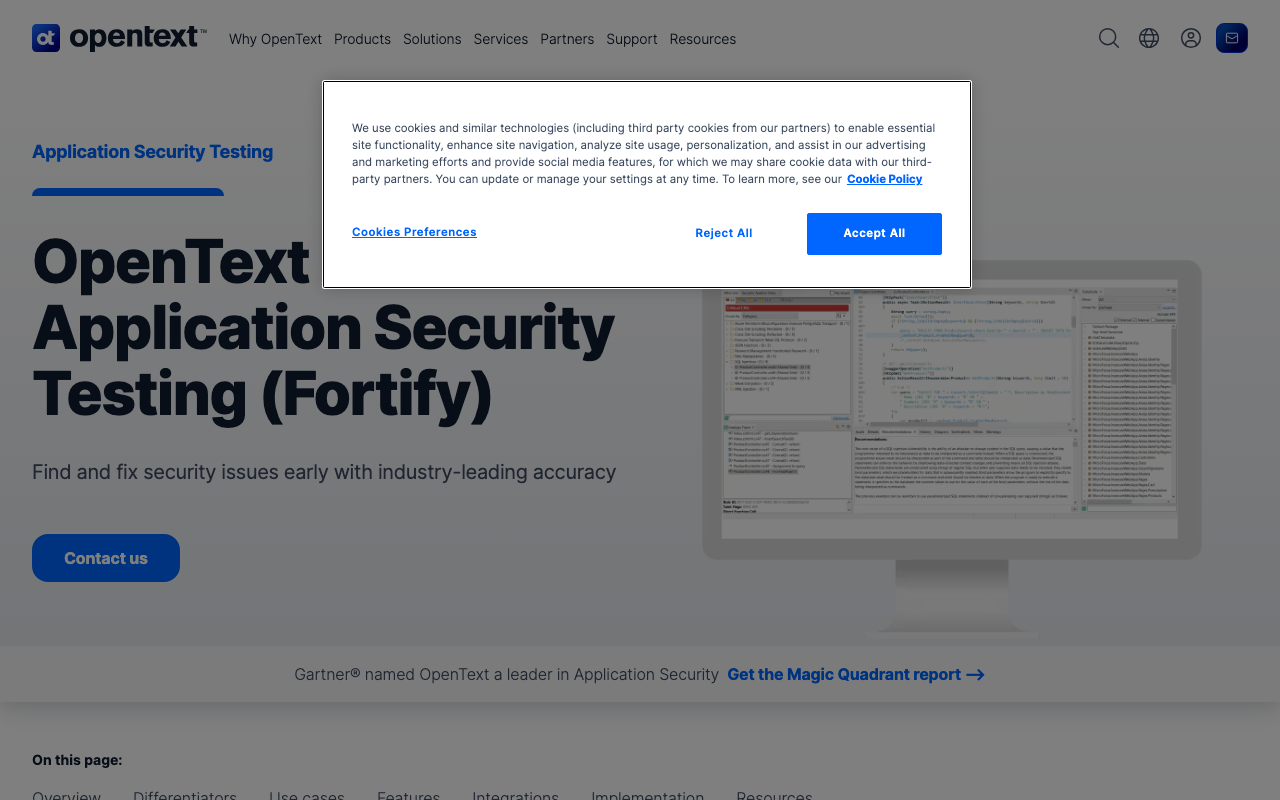
Fortify from OpenText is the legacy enterprise SAST tool that predates both Veracode and Checkmarx in the market. It has been a Gartner Magic Quadrant Leader for 11 consecutive years (matching Veracode), with Fortify Static Code Analyzer for SAST, Fortify WebInspect for DAST, and Fortify on Demand for SaaS delivery.
What makes it a strong alternative: Fortify offers genuine on-premises deployment that Veracode’s cloud-only model cannot match - critical for government agencies, defense contractors, and organizations in air-gapped environments. It covers 33+ languages and 1,500+ vulnerability categories with deep taint analysis that traces data flows through complex call chains. For teams already in the OpenText ecosystem, the integration story is straightforward. Fortify’s Audit Workbench provides granular control over finding classification and remediation tracking that experienced security teams appreciate.
Where it falls short of Veracode: Fortify’s platform feels more dated than Veracode’s, with a heavier maintenance burden for self-hosted deployments. SCA capabilities are less mature than Veracode’s (especially after Veracode’s Phylum acquisition for malicious package detection). AI-powered remediation is less developed than Veracode Fix. Developer experience and CI/CD integration are not as polished - Fortify still feels like a tool built for security teams rather than developers. The learning curve for Fortify’s custom rule language (Fortify Rulepack) is steeper than Checkmarx’s CxQL.
Migration considerations: Teams migrating from Veracode to Fortify should evaluate whether they need on-premises deployment. If they do, Fortify is one of very few options. If cloud delivery is acceptable, other tools on this list offer better developer experience at lower cost. Fortify on Demand (the SaaS offering) is comparable to Veracode’s delivery model but with less polish on the developer-facing workflows. Plan for a longer migration timeline (4-8 weeks) due to the complexity of Fortify’s self-hosted infrastructure and rule configuration.
Best for: Government, defense, and regulated industries that require on-premises deployment and cannot send code to the cloud. Also strong for organizations already invested in the OpenText/Micro Focus ecosystem.
5. Aikido Security - Best all-in-one for startups and mid-market
Rating: 4.0 | Free for up to 2 users | $300/month for 10 users
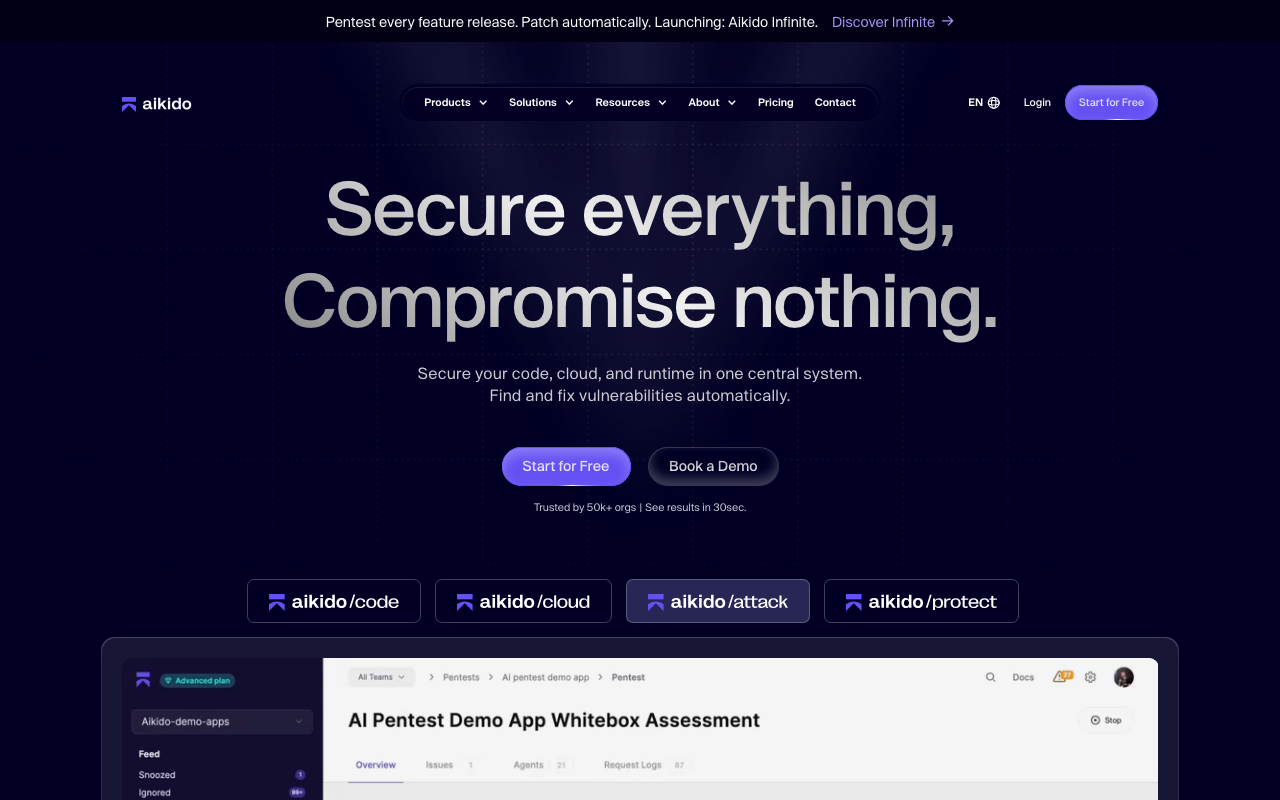
Aikido Security is the insurgent in this space - a unified AppSec platform that bundles SAST, DAST, SCA, IaC scanning, container security, secrets detection, and cloud security posture management (CSPM) at a price point that undercuts enterprise tools by an order of magnitude. Trusted by 50,000+ organizations including Revolut and SoundCloud, and valued at $1B after its $60M Series B.
What makes it a strong alternative: Aikido’s AI AutoTriage claims to reduce alert noise by 95%, addressing the biggest pain point in security scanning - finding fatigue. The platform covers nearly every security domain Veracode does - including DAST, which most developer-first alternatives lack. At $300/month for 10 users ($30/user/month), it is dramatically cheaper than Veracode’s $15,000+ entry point. The free tier supports 2 users and 10 repos with SCA, SAST, secrets detection, and cloud scanning. The breadth of coverage at this price point is unmatched.
Aikido’s runtime monitoring adds a layer that Veracode does not offer. Beyond static and dynamic analysis, Aikido monitors running applications for anomalous behavior, blocking attacks in real-time. This combines what would typically require separate RASP (Runtime Application Self-Protection) tooling with the scanning platform, reducing total toolchain cost and complexity.
Where it falls short of Veracode: Aikido is younger and less battle-tested than Veracode’s 18-year track record. Compliance reporting is less comprehensive - while Aikido covers SOC 2 and ISO 27001, its PCI DSS, HIPAA, and FedRAMP reporting depth does not match Veracode’s audit-ready documentation. The platform does not have Veracode’s binary analysis approach for legacy language support. Enterprise support tiers and dedicated customer success management are less established.
Migration considerations: Aikido offers a free tier, which makes evaluation straightforward - import your repositories and compare findings against Veracode’s output. The platform supports GitHub, GitLab, Bitbucket, and Azure DevOps integrations. Teams should expect different finding distributions because Aikido uses source-code analysis while Veracode uses binary analysis. The biggest risk is organizational - Aikido’s startup status means less brand recognition with enterprise procurement and audit teams.
Best for: Startups and mid-market teams (10-100 developers) that need broad security coverage without enterprise pricing or complexity. Especially compelling for teams that would otherwise need to stitch together 3-4 separate tools.
6. Coverity (Black Duck) - Best for C/C++ and safety-critical code
Rating: 4.3 | Free for open source | $500/developer/year (CodeSight)
Coverity, now part of Black Duck Software (formerly Synopsys Software Integrity), is a deep static analysis tool focused on finding critical defects and security vulnerabilities in mission-critical software. It takes a fundamentally different approach than Veracode, emphasizing code correctness - memory safety, concurrency bugs, resource leaks - alongside security vulnerabilities.
What makes it a strong alternative: Coverity has the lowest false positive rate among enterprise SAST tools, which matters enormously in safety-critical environments where every finding must be investigated. It supports compliance reporting for MISRA, CERT, CWE, OWASP, and AUTOSAR standards that Veracode does not cover. Coverity’s deep path-sensitive analysis is particularly strong for C, C++, and embedded systems code, where it detects buffer overflows, null pointer dereferences, use-after-free bugs, and race conditions with precision that web-focused tools cannot match. Coverity Scan provides free analysis for open source projects.
Coverity’s defect detection extends beyond security vulnerabilities. While Veracode focuses on security-relevant findings (CWE-mapped vulnerabilities), Coverity also catches reliability defects like resource leaks, uninitialized variables, dead code, and concurrency issues that cause crashes in production. For teams building embedded systems, real-time software, or safety-critical applications, these defect categories are as important as - or more important than - traditional security vulnerabilities.
Where it falls short of Veracode: No DAST, no SCA (separate Black Duck SCA tool exists but requires additional licensing), and narrower web application security coverage. Language support (22+) is more limited than Veracode’s. The platform is focused on code correctness and defect detection rather than the broad application security testing that Veracode provides. Pricing is less transparent than Veracode’s, and enterprise deployments can be expensive.
Migration considerations: Coverity is not a Veracode replacement for most web application teams. It is a complementary or alternative tool for teams whose primary concern is code correctness and safety-standard compliance rather than broad AppSec coverage. Teams migrating should map their required CWE categories to Coverity’s checker set to ensure coverage gaps are understood before committing.
Best for: Automotive, aerospace, medical devices, and embedded systems teams where code correctness and safety-standard compliance (MISRA, CERT, AUTOSAR) are non-negotiable. Also strong for any C/C++ heavy codebase where memory safety defects are a primary concern.
7. SonarQube - Best for code quality plus security
Rating: 4.5 | Free Community Build | $2,500/year (Developer Edition)
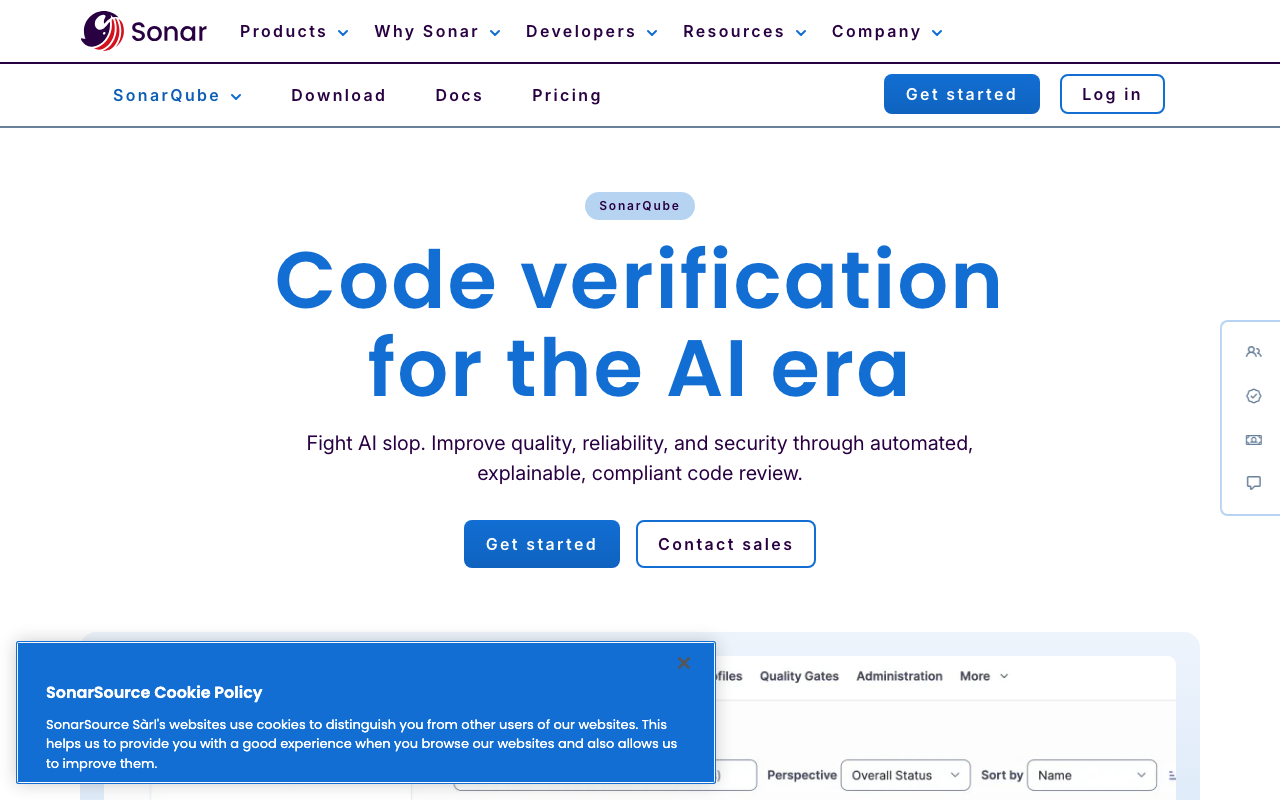
SonarQube is not a direct Veracode replacement - it is a code quality platform with security capabilities rather than a dedicated AppSec tool. But for teams whose primary pain point with Veracode is the cost and complexity of getting basic SAST into their pipeline, SonarQube’s free Community Build and affordable Developer Edition are compelling.
What makes it a strong alternative: SonarQube has 6,500+ rules across 35+ languages - the deepest rule database of any static analysis tool. Quality gates that block non-compliant merges, SonarLint IDE integration for real-time feedback, and technical debt tracking provide capabilities Veracode does not offer at all. The Developer Edition at $2,500/year is a fraction of Veracode’s cost, and the Community Build is completely free. In 2025, SonarQube Advanced Security added SCA, SBOM generation, and malicious package detection, narrowing the gap with dedicated security tools.
SonarQube’s quality gate concept addresses a gap Veracode leaves open. Veracode tells you about security vulnerabilities but does not enforce code quality standards like maintainability ratings, duplication thresholds, or coverage requirements. SonarQube’s quality gates let you define pass/fail criteria that block merges unless the code meets all standards - security, reliability, maintainability, and coverage combined. For teams that want a single gating mechanism across all code quality dimensions, SonarQube is the clear choice.
Where it falls short of Veracode: Security analysis is less comprehensive - roughly 15% of SonarQube’s rules are security-focused compared to 100% of Veracode’s. No DAST capability. Compliance reporting is less mature for regulatory frameworks like PCI DSS and HIPAA. Self-hosted deployment requires DevOps maintenance. The Community Build lacks branch analysis and PR decoration, which means you need to pay for the Developer Edition to get PR-level feedback.
Migration considerations: Many teams use SonarQube alongside Veracode or as a Veracode replacement for non-critical applications. The migration path is straightforward because SonarQube requires only source code access (no build required for most languages). Teams should expect a different finding profile - SonarQube will surface many code quality and maintainability issues that Veracode never flagged, while catching fewer deep security vulnerabilities.
Best for: Teams that need both code quality and basic security analysis in a single, affordable platform, especially those willing to pair SonarQube with a dedicated security scanner for deeper coverage.
8. Corgea - Best for AI-powered auto-remediation
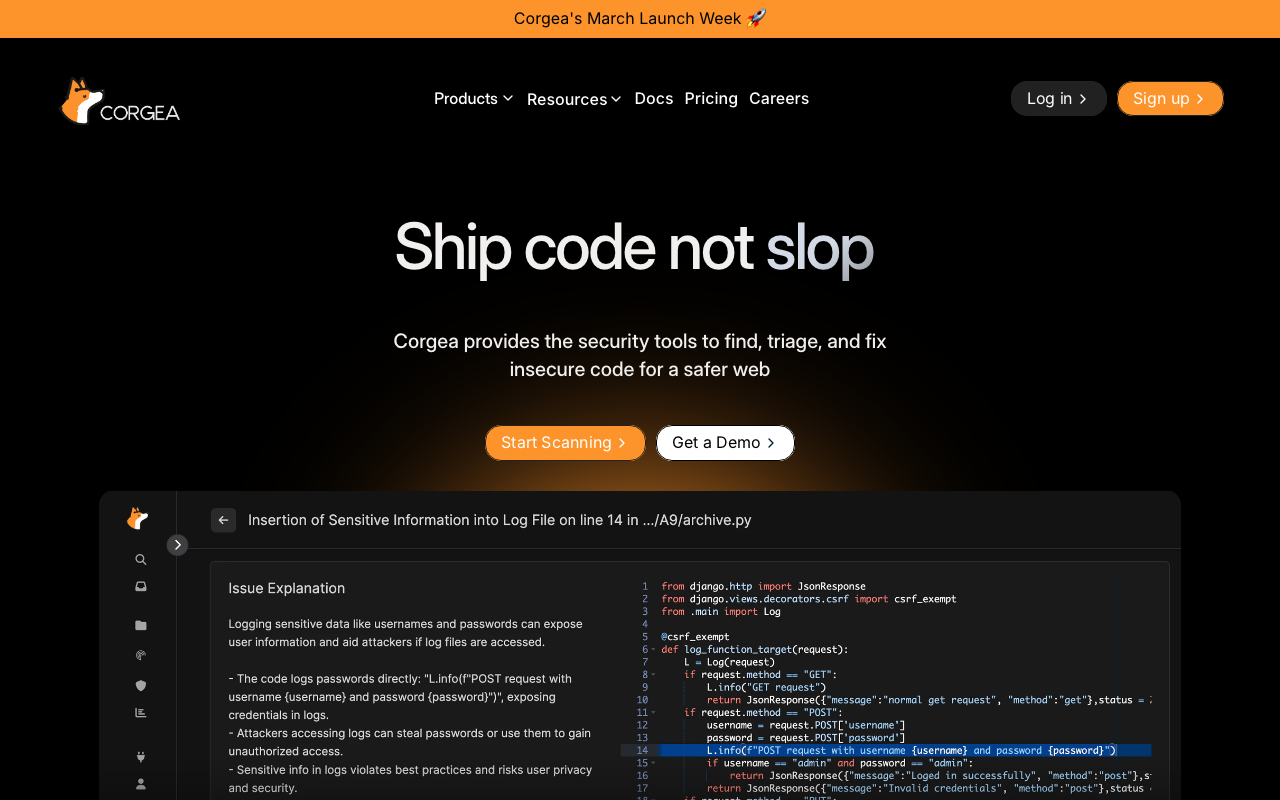
Rating: 3.9 | Free tier available | $39/developer/month
Corgea is a Y Combinator-backed AI-native security platform that does not just find vulnerabilities - it automatically fixes them. While Veracode Fix generates AI-powered remediation suggestions, Corgea’s BLAST scanner claims 20% more true positives and 90% fewer false positives than traditional SAST tools, with the Corgea Agent generating and applying fixes across the codebase.
What makes it a strong alternative: Corgea covers SAST, SCA, secrets detection, container scanning, and IaC scanning across 25+ languages with AI auto-fix at the core of the experience rather than as an add-on. The free tier includes AI SAST, dependency scanning, secrets detection, container scanning, and IaC scanning for up to 10 repos. At $39/developer/month, the Growth plan is significantly cheaper than Veracode for small-to-mid teams.
Corgea’s auto-remediation approach changes the security workflow fundamentally. Instead of generating a list of findings that developers must triage, research, and fix manually, Corgea produces pull requests with AI-generated fixes that developers review and merge. This addresses the most common complaint about security tools - that they generate more work than teams can absorb. For teams where the security backlog grows faster than the team can remediate, Corgea’s fix-first approach can break the cycle.
Where it falls short of Veracode: Corgea is a younger platform without Veracode’s track record, enterprise compliance certifications, or Gartner recognition. No DAST capability. The AI-first approach means less transparency into detection logic compared to deterministic rule engines - when Corgea flags a finding, the reasoning is less interpretable than a Semgrep rule or a Veracode CWE classification. Enterprise features and support are less mature.
Migration considerations: Corgea’s free tier makes evaluation low-risk. The main consideration is whether your team trusts AI-generated fixes enough to integrate them into production workflows. Start with Corgea on a non-critical repository to validate fix quality before broader rollout. Teams should also verify that Corgea’s finding coverage matches Veracode’s for their specific language and framework stack.
Best for: Small to mid-size teams (5-30 developers) that want AI-native security scanning with automatic remediation and cannot justify Veracode’s enterprise pricing.
9. HackerOne Code Security - Best for expert-led security reviews
Rating: 4.5 | No free tier | ~$15,000/year (Professional)
HackerOne Code Security takes a uniquely different approach by combining automated SAST, SCA, and IaC scanning with manual expert vulnerability assessment from 600+ vetted security engineers. This is the closest thing to a human-powered Veracode alternative.
What makes it a strong alternative: HackerOne’s security researchers find vulnerabilities that automated tools miss - business logic flaws, complex authentication bypasses, and race conditions that require human reasoning. The platform integrates with GitHub, GitLab, and Bitbucket for automated scanning alongside the expert review. Compliance reporting covers SOC 2, ISO 27001, PCI DSS, and FedRAMP. For organizations that need penetration testing alongside automated scanning, HackerOne bundles both capabilities.
The human element addresses automated scanning’s blind spots. Every SAST tool on this list - including Veracode - struggles with business logic vulnerabilities. An authorization bypass that requires understanding your domain model, a race condition in a payment flow, or an insecure state machine transition are all invisible to pattern matching and taint analysis. HackerOne’s expert reviewers understand these attack vectors because they think like adversaries, not pattern matchers.
Where it falls short of Veracode: No continuous automated DAST (the human reviewers provide manual dynamic testing). Per-audit pricing (~$11,400 per audit) makes it expensive for continuous scanning workflows. Automated scanning capabilities are less comprehensive than Veracode’s dedicated SAST engine. Not designed for high-frequency CI/CD pipeline integration - the expert review cadence is periodic, not per-commit.
Migration considerations: HackerOne is best used as a complement to automated scanning rather than a complete Veracode replacement. Many teams pair HackerOne’s expert reviews with a tool like Semgrep or Snyk for continuous automated coverage. Budget for quarterly or semi-annual expert reviews focused on the highest-risk components of your application.
Best for: Organizations that need expert-led security assessments alongside automated scanning, particularly for high-risk applications, pre-launch audits, and compliance certification.
Is Veracode any good?
This is one of the most common questions teams ask before evaluating alternatives, and the answer is nuanced.
Veracode is genuinely good at what it does. Its binary analysis approach catches vulnerabilities that source-code scanners miss, particularly in compiled languages and complex dependency chains. The compliance reporting is audit-ready for PCI DSS, HIPAA, SOC 2, and FedRAMP without requiring custom configuration. The eLearning platform (Security Labs) helps developers build security awareness. And 11 consecutive years as a Gartner Magic Quadrant Leader is earned through real capability, not marketing.
The problems are cost, speed, and developer experience. At $15,000+ per year for SAST alone, Veracode prices out many teams that could benefit from application security testing. The binary analysis requirement adds friction to CI/CD pipelines. The platform’s security-team-centric design creates a bottleneck where security professionals must triage and assign findings to developers, rather than developers receiving feedback directly in their workflow.
Whether Veracode is “good” depends on your frame of reference. Compared to running no SAST at all, Veracode is excellent. Compared to developer-first tools like Semgrep or Snyk at a fraction of the price, Veracode’s value proposition weakens for teams that prioritize speed and developer adoption over governance breadth.
Is SonarQube the same as Veracode?
No, and this is a common misconception worth addressing directly.
SonarQube is a code quality platform that happens to include security analysis. Roughly 15% of its 6,500+ rules target security vulnerabilities, while the rest cover bugs, code smells, maintainability issues, and technical debt. SonarQube’s strengths are quality gates (enforcing standards on every merge), technical debt tracking (quantifying maintenance burden), and development workflow integration (SonarLint in IDEs, PR decoration).
Veracode is a dedicated application security platform with 100% of its focus on finding security vulnerabilities. It provides SAST, DAST, SCA, container scanning, and compliance reporting - none of which SonarQube covers with equivalent depth.
Where they overlap is SAST. Both tools perform static analysis to find security vulnerabilities in source code. SonarQube catches common patterns (SQL injection, XSS, hardcoded credentials) but lacks the deep taint analysis, binary analysis, and cross-application correlation that Veracode provides. For basic SAST needs, SonarQube at $2,500/year is a viable alternative. For comprehensive AppSec programs, they serve different purposes and many teams run both.
What is the difference between Cycode and Veracode?
Cycode and Veracode address different layers of application security.
Veracode focuses on finding vulnerabilities in application code through SAST (scanning for coding errors that create vulnerabilities), DAST (testing running applications for exploitable weaknesses), and SCA (identifying vulnerable open-source dependencies).
Cycode focuses on securing the software development environment itself - the CI/CD pipelines, source code repositories, and developer tools that produce the application. Cycode’s Application Security Posture Management (ASPM) platform detects leaked secrets in code, unauthorized pipeline changes, misconfigurations in build systems, and code leakage to unauthorized repositories.
Think of it this way: Veracode asks “does this code have vulnerabilities?” while Cycode asks “is the environment that produces this code secure?” Both questions matter, but they require different tools to answer. Some teams use both - Cycode to secure the development pipeline, and a SAST tool (Veracode or an alternative) to scan the code that pipeline produces.
Free vs. enterprise: what you actually need
The Veracode alternatives landscape splits cleanly into two tiers, and your budget and compliance requirements determine which tier matters.
Free and low-cost options
If you can start free and scale up, these tools offer legitimate SAST capability at zero cost:
- Semgrep - Free for up to 10 contributors on the full platform. Best free SAST option for small teams that want cross-file analysis, SCA with reachability, and AI triage without paying. The free tier includes the Pro engine, not just the community rules.
- SonarQube Community Build - Free self-hosted SAST with 6,500+ rules. Limited to main branch analysis (no PR decoration), but covers more languages than any other free tool. Requires self-hosting but runs on modest hardware.
- Snyk Free - 100 SAST tests/month plus SCA, container, and IaC scanning. Enough for evaluation and small projects. The free tier is time-limited in scan count, so larger teams will outgrow it quickly.
- Aikido Free - 2 users, 10 repos, with SCA, SAST, secrets detection, and cloud scanning. Broadest free security coverage of any tool on this list.
- Corgea Free - AI SAST, SCA, secrets, container, and IaC scanning for up to 10 repos with AI auto-fix. The only free tier that includes automated remediation.
Enterprise-grade platforms
If you need enterprise compliance and breadth, these are the realistic options:
- Checkmarx - The closest 1:1 Veracode replacement with SAST, SCA, DAST, and API security in one platform. Similar pricing range, but source-code scanning instead of binary analysis.
- Fortify - On-premises deployment for government and defense. The only alternative for air-gapped environments. Longest market tenure alongside Veracode.
- HackerOne Code - Human expert review when automated tools are not enough. Best paired with an automated scanner for continuous coverage.
The combination approach
Many teams find the best value in combining two complementary tools rather than paying for a single comprehensive platform. The most popular combinations among Veracode migrants:
- Semgrep + SonarQube - Semgrep handles SAST and SCA with cross-file taint tracking, while SonarQube provides code quality gates and technical debt tracking. Total cost: $0-$10,000/year for most teams.
- Snyk + SonarQube - Snyk handles security (SAST, SCA, container, IaC), while SonarQube handles quality. Total cost: $5,000-$20,000/year depending on team size.
- Aikido + CodeRabbit - Aikido covers broad security scanning, while CodeRabbit adds AI-powered code review for logical issues. Total cost: $4,000-$10,000/year.
Migration considerations: moving off Veracode
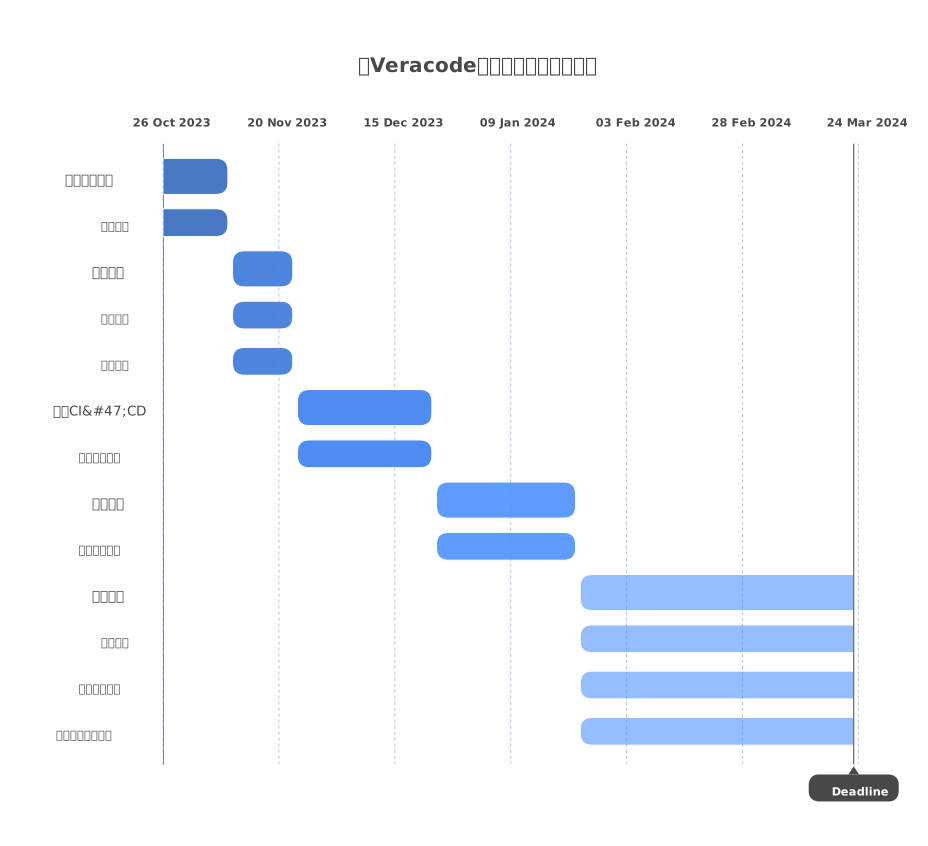
Switching application security tools is not a trivial decision. Here are the practical considerations teams should evaluate before committing to a migration.
Finding parity is not the goal - coverage parity is. Every SAST tool produces a different set of findings, even when scanning the same codebase. Veracode’s binary analysis catches certain vulnerability patterns that source-code tools miss (particularly in compiled dependency chains), while source-code tools catch patterns that binary analysis overlooks (particularly in dynamic languages and framework-specific code). Instead of trying to reproduce Veracode’s exact finding set, map your required CWE categories and verify that the alternative covers them.
Plan for a parallel evaluation period. Run the new tool alongside Veracode for 4-8 weeks on your most representative applications. Compare findings by category (not by count), assess false positive rates in your specific codebase, and measure developer adoption metrics like time-to-remediate and scan completion rates.
Account for compliance documentation. If your organization has regulatory requirements (PCI DSS, HIPAA, SOC 2, FedRAMP), verify that the alternative tool’s reporting meets auditor expectations. This often means getting your compliance team or external auditor to review the new tool’s reports before decommissioning Veracode. Some organizations have maintained Veracode specifically for audit reporting while using a different tool for day-to-day scanning.
Developer workflow changes matter more than features. A tool with fewer features that developers actually use is more valuable than a comprehensive platform that gets ignored. Evaluate the alternative’s IDE integration, PR feedback speed, and remediation guidance quality - these factors determine whether developers fix findings or ignore them.
How to choose: decision framework
Replace Veracode with a single tool? Checkmarx is the only alternative that matches Veracode’s breadth across SAST, DAST, SCA, and compliance. Aikido Security covers similar ground at a much lower price point but with less maturity and compliance depth.
Cut costs dramatically? Combine Semgrep (SAST + SCA + secrets) with SonarQube (code quality + basic security). This pairing costs under $10,000/year for most teams and covers the majority of what Veracode offers, minus DAST and enterprise compliance reporting. For teams where compliance is not a hard requirement, this is the highest-value option.
Developer experience is the priority? Snyk Code is the clear winner. It integrates into IDEs, PRs, and CI/CD pipelines with minimal configuration, and its DeepCode AI auto-fix gives developers actionable remediation rather than just alerts. Developers start getting value within 10 minutes of setup.
Need deep C/C++ analysis? Coverity. No other tool on this list matches its depth for memory safety, concurrency bugs, and safety-standard compliance. Coverity is the industry standard for embedded systems and safety-critical code.
Want AI-native security? Corgea’s BLAST scanner and auto-remediation agent represent the next generation of security tooling. Less proven than Veracode, but the AI-first approach delivers faster time-to-fix by generating pull requests instead of findings reports.
Compliance is non-negotiable? If you need PCI DSS, HIPAA, FedRAMP, or SOC 2 compliance reporting out of the box, your realistic options are Veracode, Checkmarx, Fortify, or HackerOne Code. The developer-first tools (Snyk, Semgrep, Aikido) are adding compliance features but are not yet at parity for regulated industries.
Need expert-level security review? HackerOne Code Security combines automated scanning with human expert assessment. Pair it with a continuous scanning tool for the most thorough coverage available.
Which is the best SAST tool?
This is the most-asked question in application security, and the honest answer is that it depends on your context. There is no single “best” SAST tool because the optimal choice varies by team size, budget, technology stack, and compliance requirements.
For developer-first teams (5-50 developers): Snyk Code and Semgrep offer the best balance of detection accuracy, scan speed, and workflow integration. Snyk is easier to adopt with less configuration. Semgrep is more customizable and transparent in its detection logic.
For enterprise teams (100+ developers): Checkmarx and Veracode remain the industry leaders for comprehensive SAST with enterprise governance, compliance reporting, and multi-application management. Checkmarx offers source-code scanning, while Veracode offers binary analysis.
For cost-conscious teams: SonarQube Community Build and Semgrep’s free tier provide strong SAST coverage at zero cost. SonarQube adds code quality analysis, while Semgrep focuses purely on security with deeper taint tracking.
For safety-critical industries: Coverity is the standard for C/C++ and embedded systems, with the lowest false positive rates and the deepest defect detection for memory safety issues.
The best approach for most teams is to start with a free tier (Semgrep or SonarQube), validate coverage against your requirements, and upgrade to paid tiers or complementary tools as needs evolve.
Conclusion
The application security market has fragmented significantly since Veracode’s early dominance. The right alternative depends entirely on your team size, budget, compliance requirements, and whether you prioritize developer experience or governance breadth.
For most teams outside heavily regulated enterprises, the combination of a developer-first SAST tool plus a code quality platform will deliver 80% of Veracode’s value at 20% of the cost. Semgrep plus SonarQube is the most common combination, offering cross-file SAST, SCA, secrets detection, code quality gates, and technical debt tracking for under $10,000/year.
For enterprise teams that need a full Veracode replacement, Checkmarx is the closest match across SAST, DAST, SCA, and compliance. Aikido Security is the best value if compliance depth is not a hard requirement.
For teams that want to try before they buy, start with Semgrep’s free tier (10 contributors, full platform), add SonarQube Community Build for code quality, and evaluate whether the coverage meets your needs before committing to any paid tool. This zero-cost starting point is something Veracode has never offered.
The tools on this list are all actively evolving. AI-powered triage, auto-remediation, and reachability analysis are becoming table stakes features rather than differentiators. Evaluate based on your current needs, but choose a platform with a trajectory that matches where your security program is heading.
Further Reading
- 10 Best Checkmarx Alternatives for SAST in 2026
- I Reviewed 32 SAST Tools - Here Are the Ones Actually Worth Using (2026)
- AI Code Review for Security - Finding Vulnerabilities With AI in 2026
- 11 Best SAST Tools in 2026 - Static Application Security Testing Compared
- 7 Best Semgrep Alternatives for Code Security Scanning in 2026
 Gitar
GitarComments are not enough
Gitar applies the fix, validates it in CI, and clears the queue.
See it on your repo Read our independent Gitar reviewFrequently Asked Questions
Which is the best SAST tool?
The best SAST tool depends on your team size, budget, and requirements. For developer-first teams, Snyk Code and Semgrep offer the best balance of speed, accuracy, and CI/CD integration. For large enterprises needing compliance and governance, Checkmarx and Veracode remain industry leaders. For cost-conscious teams, SonarQube Community Build and Semgrep's free tier provide strong SAST coverage at no cost.
Is SonarQube the same as Veracode?
No. SonarQube is primarily a code quality platform with security analysis as one capability - roughly 15% of its 6,500+ rules target security. Veracode is a dedicated application security testing platform covering SAST, DAST, SCA, and container security. SonarQube is stronger on code quality metrics, technical debt tracking, and maintainability. Veracode is stronger on vulnerability detection depth, compliance reporting, and dynamic analysis.
What is the difference between Cycode and Veracode?
Cycode is an application security posture management (ASPM) platform focused on securing the software supply chain and development pipeline. Veracode is an application security testing (AST) platform focused on finding vulnerabilities in application code through SAST, DAST, and SCA. Cycode focuses on CI/CD pipeline security, code leakage prevention, and developer environment hardening. Veracode focuses on vulnerability detection within the application itself.
Is Veracode any good?
Veracode is a strong enterprise application security platform - it has been a Gartner Magic Quadrant Leader for 11 consecutive years and offers comprehensive SAST, DAST, SCA, and compliance capabilities. However, its pricing starts at approximately $15,000/year for SAST alone, binary-based scanning adds CI/CD friction, and there is no free tier. For startups and mid-market teams, alternatives like Semgrep, Snyk Code, or Aikido Security offer comparable SAST at a fraction of the cost.
How much does Veracode cost per year?
Veracode SAST starts at approximately $15,000/year, SCA at approximately $12,000/year, and the full enterprise platform (SAST + DAST + SCA + container security) typically exceeds $100,000/year for large organizations. Pricing is quote-based and varies by application count, scan volume, and contract terms. There is no free tier or self-service pricing.
Can I replace Veracode with free tools?
For basic SAST and SCA coverage, yes. Semgrep's free tier (up to 10 contributors) provides cross-file SAST analysis, SCA with reachability, and secrets detection. SonarQube Community Build adds free code quality analysis with 6,500+ rules. Combined, these cover the majority of Veracode's SAST and code analysis capabilities at zero cost. However, free tools will not match Veracode's DAST, enterprise compliance reporting, or audit-ready governance features.
What is the best Veracode alternative for startups?
Semgrep and Aikido Security are the best Veracode alternatives for startups. Semgrep offers a free tier for up to 10 contributors with full SAST, SCA, and secrets detection. Aikido Security bundles SAST, SCA, DAST, and container scanning for $300/month for 10 users, which is a fraction of Veracode's cost. Both provide fast onboarding without the need for dedicated security engineering resources.
How does Snyk Code compare to Veracode?
Snyk Code scans source code directly using its DeepCode AI engine, delivering faster results than Veracode's binary-based scanning. Snyk covers SAST, SCA, container security, and IaC scanning but lacks DAST. It offers a free tier and starts at $25/dev/month, compared to Veracode's $15,000+/year starting price. Snyk provides a better developer experience with IDE plugins and real-time feedback, while Veracode offers deeper compliance reporting and broader scan coverage.
Is Checkmarx better than Veracode?
Checkmarx is the closest enterprise-grade competitor to Veracode. It scans source code directly instead of compiled binaries, which provides faster feedback and more precise line-level findings. Checkmarx supports 40+ languages versus Veracode's 30+, and offers on-premises deployment that Veracode does not. However, Checkmarx has higher false positive rates out of the box and similar or higher enterprise pricing, making it best suited for organizations that specifically need source-code SAST and on-prem deployment.
How long does it take to migrate from Veracode to another tool?
Migration timelines vary by tool and codebase complexity. Switching to Snyk Code or Semgrep typically takes 1-2 weeks for setup, CI/CD integration, and initial baseline configuration. Migrating to Checkmarx or Fortify, which have similar enterprise complexity to Veracode, usually takes 4-8 weeks including policy mapping and tuning. Plan for an additional 2-4 weeks to calibrate false positive rates and establish new remediation workflows.
Does Veracode support container scanning?
Yes, Veracode offers container scanning as part of its full enterprise platform. However, this capability is only available on higher-tier plans that typically cost $100,000+/year. Alternatives like Snyk, Aikido Security, and Semgrep also offer container scanning at significantly lower price points. Semgrep includes container and IaC scanning in its $35/contributor/month plan, and Snyk includes it in its free tier with limited scans.
What is the difference between SAST and DAST?
SAST (Static Application Security Testing) analyzes source code or compiled binaries without running the application, catching issues like SQL injection patterns, insecure configurations, and hardcoded credentials. DAST (Dynamic Application Security Testing) tests the running application by sending requests and analyzing responses to find runtime vulnerabilities. Veracode offers both SAST and DAST, but most Veracode alternatives like Semgrep, Snyk Code, and SonarQube focus on SAST only.
Is Fortify a good alternative to Veracode?
Fortify is a strong alternative for organizations that need on-premises deployment in air-gapped environments, such as government agencies and defense contractors. It matches Veracode's 11-year Gartner Magic Quadrant Leader status and supports 33+ languages with deep taint analysis. However, Fortify's platform feels more dated than Veracode's, requires heavier maintenance for self-hosted deployments, and its developer experience is less polished than modern alternatives like Snyk and Semgrep.
Which Veracode alternative has the best developer experience?
Snyk Code and Semgrep offer the best developer experience among Veracode alternatives. Snyk provides IDE plugins with real-time feedback, inline fix suggestions, and a clean dashboard that developers can navigate without security training. Semgrep scans complete in under 30 seconds in CI and uses human-readable YAML rules. Both tools integrate natively into pull request workflows, delivering findings where developers already work rather than in a separate security portal.
Explore More
Tool Reviews
 Veracode Review
 Snyk Code Review
 Semgrep Review
 Checkmarx Review
 Fortify Review
 Aikido Security Review
 Coverity (Black Duck) Review
 SonarQube Review
 Corgea Review
 HackerOne Code Security Review
Free Newsletter
Stay ahead with AI dev tools
Weekly insights on AI code review, static analysis, and developer productivity. No spam, unsubscribe anytime.
Join developers getting weekly AI tool insights.
Related Articles
8 Best CodeRabbit Alternatives for AI Code Review in 2026
Looking beyond CodeRabbit? Compare 8 top AI code review alternatives with real features, pricing, honest pros/cons, and team recommendations.
February 17, 2026
alternativesQodo AI Alternatives: 11 Best AI Test Gen Tools
Compare 11 Qodo alternatives for AI test generation and code review. Real pricing, feature comparisons, and honest trade-offs for each tool.
March 3, 2026
alternativesSourcery AI Alternatives: 10 Best Code Quality Tools in 2026
Compare 10 Sourcery alternatives for AI code review, Python linting, and code quality. Features, pricing, and honest recommendations.
March 17, 2026