 Gitar
Gitar Ship AI-generated code without drowning in review
AI agents that review, fix, validate, and migrate code across every repo. Hybrid static analysis plus LLMs, now part of Sonar.
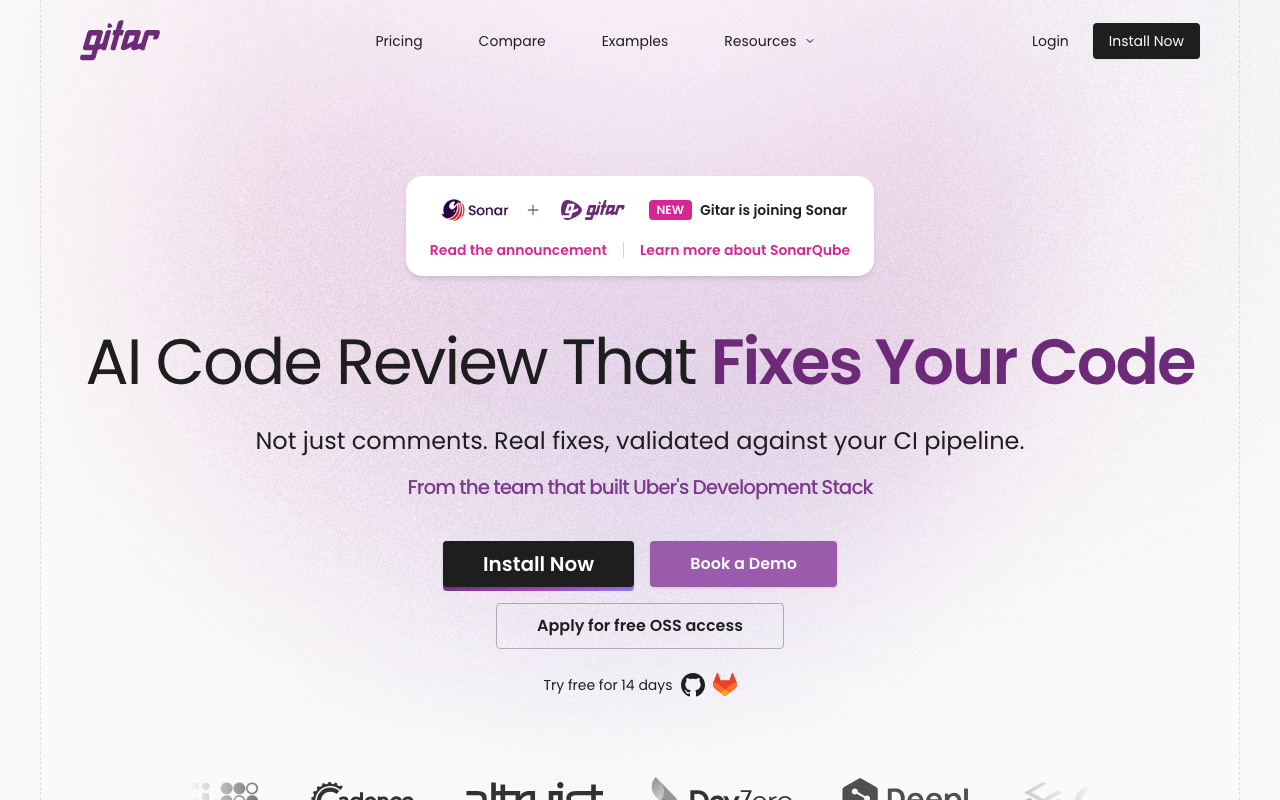
Gitar is our exclusive AI code review partner. The copy in this panel is supplied by Gitar. Everything below it - the rating, pros, cons, and verdict - is written independently and was not changed for the partnership.
Gitar Review (2026)
AI agents for code review, CI workflows, and automated code migrations. Combines static analysis with LLMs to validate, fix, and ship AI-generated code at scale. Acquired by Sonar in May 2026.
Rating
Starting Price
$20/user/month
Free Plan
No
Languages
10
Integrations
6
Best For
Engineering organizations shipping large volumes of AI-generated code that need automated validation, migration, and CI cleanup across many repositories.
Last Updated:
10 Things You Should Know About Gitar
- 1 Founded by Ali-Reza Adl-Tabatabai, previously at Intel Labs, Google, and Uber
- 2 Emerged from stealth on April 15, 2026 with $9M in funding led by Venrock with participation from Sierra Ventures
- 3 Acquired by Sonar (the company behind SonarQube and SonarCloud) on May 21, 2026
- 4 At Uber, the team behind Gitar generated 4,881 pull requests in six months across Thrift-to-gRPC and feature flag cleanup migrations
- 5 Targets six migration categories with automation potential ranging from 40% (service consolidation) to 90% (API deprecations)
- 6 Built to validate output from any AI coding agent including Claude Code, Cursor, Codex, Devin, and GitHub Copilot
Pros & Cons
Pros
- ✓ Goes beyond commenting - actually rewrites code and validates against CI
- ✓ Hybrid static analysis + LLM design reduces hallucinations versus pure-LLM reviewers
- ✓ Battle-tested migration approach (Uber generated 4,881 PRs in 6 months across major migrations)
- ✓ Founders previously built similar tooling at Intel, Google, and Uber
- ✓ Acquisition by Sonar gives it the deepest verification engine in the market
- ✓ Designed specifically to validate AI-generated code from any agent
- ✓ Natural language CI workflows lower the configuration barrier
Cons
- ✕ No permanent free tier for private repos - just a 14-day trial
- ✕ Standalone product in transition after May 2026 Sonar acquisition
- ✕ Core plan and Pro plan both cap out at 50 users, so scaling past that means an Enterprise conversation
- ✕ Migration-grade automation is enterprise-only in practice
- ✕ Smaller community and fewer public benchmarks than CodeRabbit or Qodo
- ✕ Less mature IDE integration compared to AI assistants
Features
Gitar Overview
Gitar is an AI-native code review and workflow automation platform built for the post-generation era. Where most AI code review tools stop at posting comments on a pull request, Gitar goes a step further and actually applies fixes, deduplicates CI failures, retries flaky tests, and automates large-scale code migrations across entire codebases. The product is positioned around a specific bet: that the bottleneck for engineering teams in 2026 is no longer code generation - it is validating the flood of code that AI agents now produce.
The company emerged from stealth on April 15, 2026 with $9 million in funding led by Venrock with participation from Sierra Ventures. Roughly five weeks later, on May 21, 2026, Sonar (the company behind SonarQube and SonarCloud) acquired Gitar to plug AI-native code review into its established verification platform. As of mid-2026, Gitar’s product is in the early stages of being unified with the broader Sonar suite, but its independent capabilities remain available through GitHub and GitLab integrations.
Gitar’s founder and CEO, Ali-Reza Adl-Tabatabai, previously led developer infrastructure work at Intel Labs, Google, and Uber. At Uber, his team built internal tooling that generated 4,881 pull requests in six months across major migrations including Thrift-to-gRPC conversions and feature flag cleanup, work that the company has publicly cited as the design inspiration for Gitar’s migration engine.
What Makes Gitar Different
Most AI code review tools - including CodeRabbit, Qodo Merge, and Greptile - focus on the quality of inline review comments. They read the diff, generate suggestions, and post them as PR threads. Gitar’s bet is different: comments are not enough when AI agents are producing 10x or 100x more code than humans can manually review.
Three design choices set Gitar apart from the broader AI code review category:
1. Hybrid static analysis + LLMs. Pure-LLM reviewers are prone to hallucinations on complex codebases - confidently suggesting fixes that break the build or misunderstand framework semantics. Gitar combines static analysis (for precision on syntax, dependency graphs, and type information) with LLMs (for contextual reasoning about intent). The static layer constrains what the LLM is allowed to suggest, which materially reduces false positives.
2. Fix-and-validate, not just comment. When Gitar identifies an issue, it can generate the fix, apply it as a commit, and validate the result against your CI pipeline before the PR is merged. This is meaningfully different from suggesting a snippet that a developer has to manually apply. For high-volume AI-generated PRs, this is the difference between a tool that creates more review work and one that actually clears the queue.
3. CI workflow ownership. Gitar is not just a reviewer - it operates on the CI pipeline itself. It deduplicates build failures across runs, retries flaky tests automatically, and lets teams define custom CI agents in natural language for tasks like policy enforcement, PR summaries, and lint rule additions. This is closer to what a build engineer does than what a code reviewer does.
Founder Ali-Reza Adl-Tabatabai put it directly in the company’s launch announcement: “Generation produces code; validation makes it trustworthy. Gitar is the workflow agent that owns that process, orchestrating reviews, tests, and diagnostics end to end.”
Feature Deep Dive
AI Code Review with Real Fixes. Gitar reviews every pull request against the full repository context, identifying bugs, formatting inconsistencies, and quality issues. Rather than posting suggestions for a developer to apply, it generates and commits the fix directly, then validates it against the CI pipeline. This works well for the common patterns that dominate AI-generated PRs - missing error handling, unused imports, type mismatches, edge cases the generator did not consider.
CI Failure Analysis. Gitar sits in the CI pipeline and automatically deduplicates build failures across runs, detects and retries flaky tests, and distinguishes genuine code-change issues from infrastructure noise. For teams running large monorepos with hundreds of PRs per day, this alone can collapse hours of build-debugging work into minutes.
Natural Language CI Workflows. Teams can define custom CI agents using plain-English prompts - things like “assign new security findings to the security team,” “summarize this PR for the release notes channel,” or “block any PR that adds a TODO without a linked ticket.” This lowers the configuration barrier compared to writing YAML pipelines or custom GitHub Actions.
Automated Code Migrations. Gitar’s migration engine targets six categories with different automation potentials: framework/library upgrades (around 80%), API changes and deprecations (around 90%), language migrations (around 70%), build system conversions (around 70%), cross-language/platform shifts (around 60%), and service consolidation (around 40%). The system identifies outdated APIs, refactors patterns, and updates configurations across large codebases - the same playbook that generated 4,881 PRs at Uber in six months.
Agent-Agnostic Validation. Gitar is explicitly designed to validate output from any AI coding tool - Claude Code, Cursor, Codex, Devin, GitHub Copilot, or anything else. This is increasingly important as engineering organizations adopt multiple AI assistants and need a unified quality gate that does not depend on which agent wrote which line.
Fleet View for Tech Leads. For organizations managing dozens or hundreds of repositories, Gitar provides a cross-repo view of pending PRs, review status, and CI health. This is the kind of capability that becomes essential when a single tech lead is nominally responsible for many services.
Pricing and Plans
Gitar published self-serve pricing after the Sonar acquisition in May 2026, which removes the sales gate that used to be the biggest objection to the product. Core is $20/user/month and Pro is $40/user/month. Both cover unlimited public and private repos on GitHub and GitLab and both cap at 50 users. Enterprise is custom-priced and is where self-hosting, bring-your-own-LLM keys, API access, SSO/SAML, and the migration automation live.
The line between Core and Pro matters more than the price gap suggests. Core reviews and suggests; Pro is the tier that actually auto-applies fixes, blocks merges, and runs the advanced CI analysis across CircleCI, Buildkite, and Bitrise. Since applying fixes is the whole reason to pick Gitar over a commenting reviewer, most teams evaluating it should price it at $40, not $20.
There is a 14-day trial of the full platform with no card required, and public repos under an OSI-approved license (MIT, Apache-2.0, GPL and similar) get Pro features free indefinitely. What does not exist is a permanent free tier for private repos - so for a hobby project in a private repo, CodeRabbit’s free tier or the self-hostable open-source Qodo Merge PR-Agent remain the cheaper starting points.
How Gitar Works
Installation. Gitar installs as a GitHub or GitLab app. After authorization, it begins reviewing pull requests and observing CI runs automatically. There is no required configuration for the baseline review and CI failure analysis features.
The Review Cycle. On each new PR or push, Gitar fetches the diff, runs its static analysis layer, invokes the LLM for contextual reasoning, and posts a review. Where it has high confidence, it can apply the fix directly as a commit and run CI to verify. Lower-confidence findings are posted as suggestions in the PR thread.
CI Integration. Gitar plugs into common CI systems including CircleCI, Buildkite, and Jenkins. It observes build runs, identifies failures, and applies its dedup and retry logic. Custom CI agents defined in natural language run as part of the pipeline alongside existing jobs.
Migration Projects. Migrations are configured as targeted projects against specific codebases. The team defines the source pattern (e.g., legacy API, deprecated library version) and target state, and Gitar generates and validates PRs across affected files. Large migrations can run over weeks or months with continuous PR generation.
Who Should Use Gitar
Engineering organizations shipping AI-generated code at scale are the core fit. If your team has adopted Claude Code, Cursor, or Copilot widely and is now buried in PRs that need human review, Gitar’s fix-and-validate model directly addresses that bottleneck. The cost-benefit math becomes obvious once review backlog starts blocking releases.
Companies with large migration projects - framework upgrades, API deprecations, language shifts, service consolidation - are the second core fit. The migration engine has direct production lineage from Uber, and the documented automation potential (60-90% across migration categories) makes the ROI quantifiable.
Enterprises evaluating Sonar’s verification stack should consider Gitar as the AI-native front end to that platform now that the acquisition is complete. The combination of Gitar’s AI review plus Sonar’s deterministic static analysis and security scanning is one of the few enterprise-grade AI code review stories that does not feel like a bolted-together demo.
Teams NOT well served by Gitar include solo developers and small teams without budget for an enterprise platform, open-source maintainers (consider CodeRabbit for free), teams that need only inline comment-style review without workflow automation, and organizations strictly opposed to LLM-based review (consider SonarQube or Codacy).
Gitar vs Alternatives
Gitar vs CodeRabbit. CodeRabbit is the volume leader in AI PR review with 500K+ developers and a generous free tier. Its strength is comment quality and self-serve adoption. Gitar’s strength is workflow automation - applying fixes, validating against CI, automating migrations. CodeRabbit is the better choice for teams that want fast, configurable AI reviews at low cost. Gitar is the better choice for teams that need post-generation workflow ownership and enterprise-grade migration automation. Full breakdown: Gitar vs CodeRabbit.
Gitar vs Qodo Merge. Qodo Merge (formerly CodiumAI) offers an open-source PR-Agent that can be self-hosted, which is valuable for security-conscious teams. Gitar does not have an open-source path, and it does not generate tests the way Qodo does. However, Gitar goes deeper on CI workflow automation and migrations, areas where Qodo Merge does not really compete. Full breakdown: Gitar vs Qodo.
Gitar vs Greptile. Greptile indexes the entire codebase and has published third-party benchmark results, which Gitar has not. Greptile finds more; Gitar does more with what it finds - applying fixes, validating them in CI, and owning pipeline health. Both are GitHub and GitLab only, and neither has a permanent free tier for private repos. Full breakdown: Gitar vs Greptile.
Gitar vs SonarQube (the parent platform). SonarQube is deterministic, rule-based static analysis with 30+ language coverage and a mature self-hosted story. Gitar is AI-native and workflow-focused. After the May 2026 acquisition, the two are increasingly sold together as complementary layers in Sonar’s stack - SonarQube for deterministic quality and security gates, Gitar for AI-driven review and workflow automation.
Gitar vs GitHub Copilot Code Review. Copilot Code Review is bundled into Copilot Enterprise and provides native GitHub integration. Gitar is platform-agnostic (GitHub and GitLab) and goes much deeper on workflow automation, CI integration, and migrations. Copilot Code Review is the simpler choice for GitHub-only teams already on Copilot Enterprise. Gitar is the choice for teams that need more than comment-level review.
Pros and Cons Deep Dive
Strengths:
The hybrid static analysis + LLM design is the most important differentiator. Pure-LLM reviewers are prone to confidently wrong suggestions on complex codebases. By constraining the LLM with static analysis (type information, dependency graphs, syntax trees), Gitar materially reduces hallucinations. This matters more as PR volume scales - the false positive rate of a pure-LLM tool can become unbearable above a few dozen PRs per day.
The fix-and-validate workflow is the second differentiator. Review tools that only post comments require human action to close the loop. Gitar can close the loop itself: generate the fix, commit it, run CI, confirm the result. For high-volume teams this is a categorical difference, not a marginal one.
The migration engine has real production proof. The Uber numbers (4,881 PRs in six months) are not synthetic benchmarks - they reflect actual completed migrations including Thrift-to-gRPC and feature flag cleanup. Combined with the public 60-90% automation estimates across migration categories, this is one of the few migration tools with credible scale evidence.
The Sonar acquisition is a strategic asset, not just a liquidity event. SonarQube has been the default enterprise static analysis tool for over a decade. Combining that distribution with Gitar’s AI review gives the joint product a credible enterprise sales motion that pure startups in the category lack.
Weaknesses:
No permanent free tier for private repositories. The 14-day trial and free OSS access fix the old “you cannot try it without a sales call” problem, but a solo developer with a private side project still has nothing to run long-term, and that is a segment the AI code review market rewards. The 50-user ceiling on both self-serve tiers is the other edge of the same choice: cross it and you are back in an Enterprise conversation.
The standalone product is in transition. Following the May 21, 2026 Sonar acquisition, Gitar’s roadmap, pricing, and feature set are being unified with the broader Sonar platform. Buyers should expect some churn in product positioning over the next 6-12 months.
Smaller community and fewer public benchmarks than incumbents. CodeRabbit publishes scale metrics regularly and is the subject of multiple independent benchmarks. Gitar is newer, more enterprise-focused, and has less public performance data, which makes objective comparisons harder.
Less mature IDE integration than AI coding assistants. Gitar is a workflow tool that operates at the PR and CI level. If you want inline AI review in your editor, you will need to pair it with Cursor BugBot, Claude Code, or similar.
Pricing Plans
Core
$20/user/month
- Unlimited public and private repos on GitHub and GitLab
- Up to 50 users
- Customizable AI code reviews and PR summaries
- CI failure analysis
- Fixes requested via PR comments
- Interactive agent and developer insights
Pro
$40/user/month
- Everything in Core
- Auto-apply fixes and merge blocking
- Auto-approve on clean reviews
- Advanced CI analysis (CircleCI, Buildkite, Bitrise)
- Slack, Linear, and Jira integrations
- Custom checks and automations
- Free for public repos under an OSI-approved license
Enterprise
Contact sales
- Everything in Pro
- Unlimited repos and users
- Automated code migrations (framework upgrades, API deprecations, language shifts)
- Self-hosted GitHub/GitLab and custom deployment
- Bring your own LLM API key
- API access and custom integrations
- SSO/SAML, audit logs, and dedicated support
Supported Languages
Integrations
Our Verdict
Gitar sits in a different lane from most AI code reviewers. Instead of competing on comment quality, it owns the entire post-generation workflow - review, fix, validate, migrate. The hybrid static-analysis + LLM design produces materially fewer hallucinations than pure-LLM tools, and the migration playbook has real production proof from Uber. Following the Sonar acquisition in May 2026, Gitar becomes the AI-native front end to the broader Sonar verification platform, which puts it in a strong position for enterprises trying to govern AI-written code at scale. Pricing is now public and self-serve at $20 and $40 per user per month, with a 14-day trial and free Pro access for OSI-licensed public repos, so the old sales-gate is gone. The remaining caveats are the 50-user ceiling on both self-serve plans and the product's ongoing integration into Sonar, which will keep the positioning moving for the next few quarters.
Similar Tools

CodeRabbit
Teams wanting the most capable AI-powered PR reviews with natural language customization and broad platform support

Ito
Teams shipping AI-generated changes to web apps who want a behavioral gate before merge, and open-source maintainers who need protection against regressions in community contributions.

Cursor BugBot
Development teams already using Cursor IDE that want high-signal, low-noise AI bug detection focused on logic errors and security issues rather than style enforcement

GitHub Copilot Code Review
Teams already using GitHub and Copilot who want native AI code review without adding another tool to their workflow
Frequently Asked Questions
What is Gitar?
Gitar is an AI code review and workflow automation platform that validates code after it has been written. It runs reviews that apply real fixes, deduplicates CI failures, retries flaky tests, and automates large-scale code migrations. It is designed specifically to catch issues in code generated by AI agents like Claude Code, Cursor, Codex, Devin, and GitHub Copilot.
Who founded Gitar?
Gitar was founded by Ali-Reza Adl-Tabatabai, who previously worked at Intel Labs, Google, and Uber. At Uber his team built internal tooling that generated 4,881 pull requests in six months across major migrations including Thrift-to-gRPC and feature flag cleanup, work that informs Gitar's product approach.
Was Gitar acquired?
Yes. Sonar - the company behind SonarQube and SonarCloud - acquired Gitar on May 21, 2026, roughly five weeks after Gitar's stealth exit. Sonar is integrating Gitar's AI code review capabilities into its broader code verification platform to address enterprise needs around AI-generated code quality.
How is Gitar different from CodeRabbit or Qodo Merge?
Gitar focuses on post-generation workflow automation rather than just commenting. It applies real code fixes, validates them against CI, deduplicates build failures, retries flaky tests, and automates migrations - workflow capabilities that CodeRabbit and Qodo Merge do not offer at the same depth. Gitar also combines static analysis with LLMs in a hybrid design rather than relying purely on LLM output, which reduces hallucinations on complex codebases.
What kinds of code migrations does Gitar automate?
Gitar targets six migration categories: framework and library upgrades (around 80% automation potential), API changes and deprecations (around 90%), language migrations (around 70%), build system conversions (around 70%), cross-language or cross-platform shifts (around 60%), and service consolidation (around 40%). The system identifies outdated patterns, refactors code, and updates configurations across large codebases.
Does Gitar have a free plan?
There is no permanent free tier for private repositories, but there are two ways to use Gitar without paying. Every account gets a 14-day free trial of the full platform with no credit card required, and public repositories under an OSI-approved license (MIT, Apache-2.0, GPL and similar) get Pro plan features at no cost. For private repos, paid plans start at $20/user/month (Core) and $40/user/month (Pro).
Which platforms and CI systems does Gitar support?
Gitar integrates with GitHub and GitLab for source control, and supports common CI systems including CircleCI, Buildkite, and Jenkins. After the Sonar acquisition, Gitar's capabilities are also being unified with the broader Sonar verification platform.
Related Articles
Best AI Code Review Tools in 2026 - Expert Picks
16 AI code review tools tested on TypeScript, Python, Go, and Java codebases. Features, pricing, detection quality, and false positive rates compared.
February 10, 2026
reviewIto Review 2026: The Code Reviewer That Actually Runs Your App
Hands-on Ito review. How agentic QA works, what lands on your PR, the 45-minute-to-2-hour run time, real pricing including the $3 per-review charge, and where it fits next to CodeRabbit and Playwright.
July 31, 2026
comparisonGitar vs CodeRabbit: Fix-and-Validate or Best-in-Class Comments?
Gitar vs CodeRabbit compared on review model, CI ownership, migrations, pricing, platform support, and evaluation risk. An honest breakdown of which one fits your team.
August 12, 2026