Ito Review 2026: The Code Reviewer That Actually Runs Your App
Hands-on Ito review. How agentic QA works, what lands on your PR, the 45-minute-to-2-hour run time, real pricing including the $3 per-review charge, and where it fits next to CodeRabbit and Playwright.
Published:
Last Updated:
Quick Verdict
Every AI code review tool we have covered on this site reads your pull request. Ito runs it.
That is the entire pitch and it is a genuinely good one. Static analyzers match a diff against rules. LLM reviewers reason about what a diff probably does. Both are working from the text of a change, which means both are making an educated guess about behavior. Ito builds a disposable copy of your app from source in a sandbox, opens it in a real browser, clicks through the flows your change touches, and reports what actually happened - with video.
The catch is the clock. A run takes 45 minutes to 2 hours. That is not a code review in any sense a developer recognizes; it is a pre-merge gate. Ito is also GitHub-only and web-and-API-only, and the pricing has a consumption charge that can get away from you on a busy repository.
Short version: if you ship a web app and AI writes a meaningful share of your diffs, Ito covers a failure class nothing else in your stack reaches, and you should run it as a gate behind a fast reviewer rather than instead of one. We rate it 4.8/5 and place it second overall in our directory, behind only CodeRabbit, which keeps the top slot on breadth, speed, and platform coverage rather than on what it can find. If you are on GitLab or your critical path is mobile, it is not usable today.
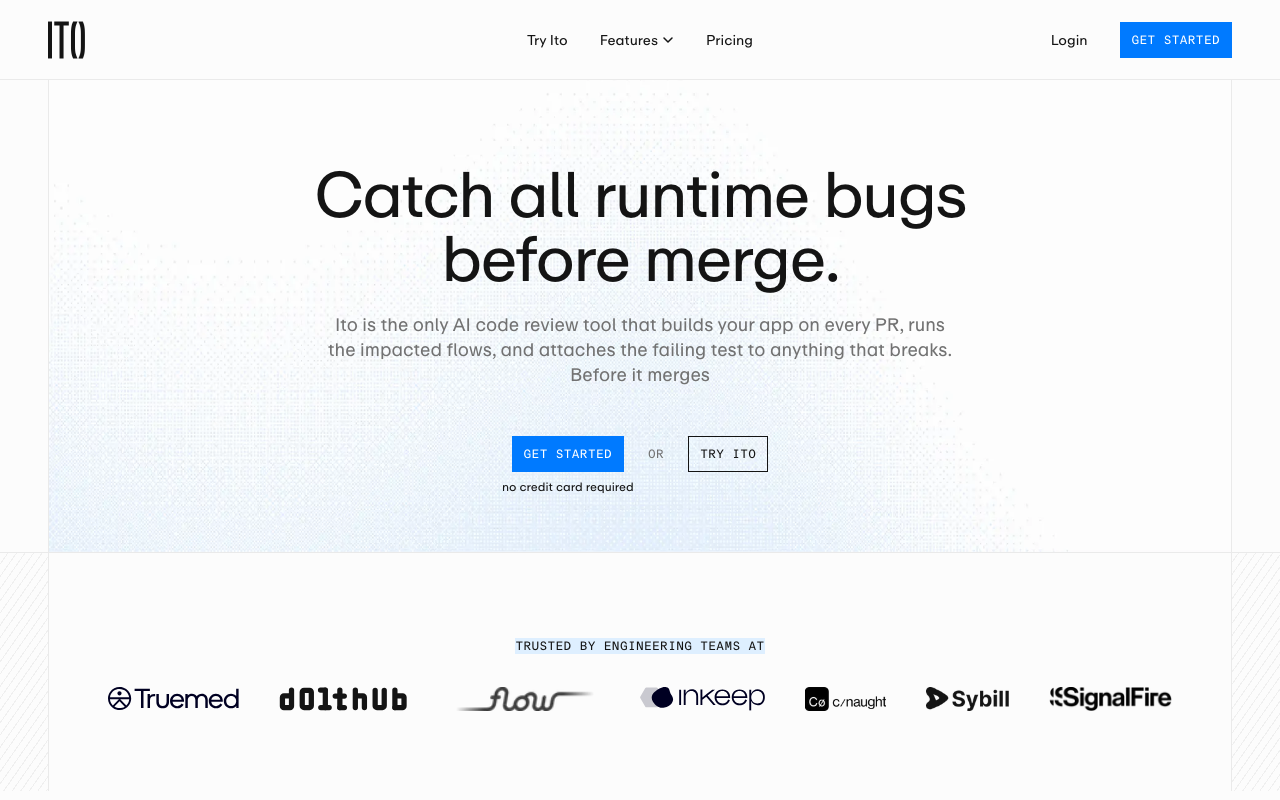
The Problem Ito Is Actually Solving
The argument for this product is worth stating precisely, because it is not the usual “AI, but for code review” claim.
The volume of code in a pull request has gone up sharply and the share of it written by an agent has gone up with it. Meanwhile every tool that inspects that code - the human reviewer, the linter, the static analyzer, the LLM bot - inspects it by reading. None of them execute it. Which means in a lot of shops, the first thing that runs an AI-written change is production.
Ito’s framing of the gap is that the first execution should happen before merge, automatically, without anyone writing a test for it. Their internal term for the cost being paid today is the “code review tax”: roughly 3 hours a week per engineer spent on manual verification.
You do not have to accept the vendor’s numbers to accept the shape of the problem. A tool that reads a diff cannot tell you that checkout broke. That is not a quality-of-model issue; it is a category issue.
How It Works
Three stages, and what matters is that each does something a diff-reader structurally cannot.
1. Observe. A PR opens. Ito reads the diff and the PR description and infers which user flows the change could plausibly affect. This step replaces the written test plan, which is why there is no script to author and nothing to maintain when the code moves.
2. Execute. Ito builds a disposable copy of the app from your source in a containerized sandbox and drives it like a user - navigating the interface, triggering backend logic, walking the affected paths. This is the expensive stage and the reason for the run time.
3. Validate. Instead of checking that code exists or matches a pattern, Ito checks outcomes. Did the checkout complete? Did the form submit? Does the flow that worked last week still work?
Setup is a GitHub app install. No test framework, no browser drivers, no CI pipeline changes. Ito states about 60 minutes from install to a first tested PR, which is consistent with a product whose entire premise is that the setup cost is what kills end-to-end testing at most companies.
What Lands on the Pull Request
This is the part of the product I would actually pay for, and it is worth being specific, because “we found a bug” is nearly worthless without what follows it.
Each run posts a summary of which flows passed and failed. Each failure carries:
- A video replay of the run
- The lines of code Ito holds responsible
- Reproduction steps
- A severity rating for triage
Push a fix and the run retriggers automatically.
The video is the piece that changes the economics of a failing test. The cost of a red end-to-end run is rarely the fix. It is the twenty minutes spent reproducing the failure locally before you can begin. Watching the failure happen removes most of that, and it is the reason I would rather have one Ito failure than five well-written linter warnings.
Pricing, and the Number to Watch
| Plan | Price | What you get |
|---|---|---|
| Open Source | Free | Runtime analysis on unlimited public repos, video and screenshots per run, one-click GitHub install. Qualified non-commercial MIT or Apache projects only |
| Pro | $40/seat/month | Unlimited repos, 20 code reviews per seat included, then $3 per additional review, unlimited read-only users, custom rules, team insights |
| Enterprise | Custom | Everything in Pro plus security and compliance review, enablement, custom DPAs and invoicing, higher limits |
First 5 pull requests are free for everyone, no card required.
The seat price is not the number to model. The $3 marginal review is.
Twenty included reviews per seat per month sounds comfortable until you put it against real PR volume. Five engineers opening four PRs a week each is around 80 PRs a month against 100 included runs, which looks fine on paper. Then count re-runs. Every fix pushed to a failing PR triggers another run, and a PR that takes three attempts to go green has consumed four runs, not one. A team that is genuinely using the tool as a gate - which is the intended use - will burn through the allowance faster than the PR count suggests.
Model your PR volume multiplied by your realistic attempts-to-green before you commit. On a busy repo the overage can quietly exceed the subscription.
This is not specific to Ito, and it is worth recognising as a category-wide shift rather than one vendor’s pricing quirk. AI tooling is moving from per-seat to per-unit billing across the board, because inference costs scale with usage in a way that seat licences do not. The same model turned up first in AI customer support, where vendors bill per resolution - and our sister site’s breakdown of per-resolution billing traps documents the identical failure: the included allowance looks generous against ticket volume, then retries, escalations, and multi-turn conversations each consume a unit, and the real bill lands well above the quoted one.
The lesson transfers directly. With per-unit pricing, the number that matters is never the headline rate. It is your retry multiplier - how many billable units one piece of work actually consumes before it is done.
The open-source tier, by contrast, is unusually generous. Free runtime analysis with video on unlimited public repos is a real offer, and open-source maintainers are precisely the people most exposed to regressions from drive-by community contributions.
Ito vs Playwright and Cypress
The obvious question for anyone who already has an end-to-end suite.
What Ito replaces: the writing and the maintenance. There are no scripts to author, and nothing breaks when a developer renames a CSS class or restructures a component. Selector churn is the single biggest reason hand-written E2E suites rot, and Ito’s agents work from application logic rather than fixed selectors.
What Ito does not replace, yet: intentional coverage. Your Playwright suite tests the paths you decided matter. Ito tests the paths it infers from the diff. Those overlap heavily but they are not the same guarantee, and if you have a critical flow that is business-important but rarely touched by diffs, an inferred test plan may simply not visit it.
The honest recommendation: run both for a quarter. Compare what each catches. If Ito is consistently finding the regressions your suite finds plus a tail of things it does not, retiring the brittle parts of the suite becomes a defensible decision. Deleting first and checking later is not.
Ito vs the Diff Readers
Ito is not competing with CodeRabbit, Qodo, or Gitar, and treating it as an alternative to them is the fastest way to be disappointed by it.
| Diff readers (CodeRabbit, Qodo, Gitar) | Ito | |
|---|---|---|
| What it inspects | The text of the change | The running application |
| Time to feedback | 2-5 minutes | 45 minutes - 2 hours |
| Catches | Logic errors, security patterns, style, cross-file issues | Broken flows, regressions, execution-time side effects |
| Role in the workflow | Feedback while the developer is still working | Gate before merge |
| Evidence produced | Comments and suggestions | Video, repro steps, responsible lines |
The layered setup is the one that works: something fast reviewing the diff in the first few minutes so feedback arrives while the change is still in the author’s head, and Ito running in the background as the behavioral check that has to be green before merge. The overlap between what the two find is smaller than you would guess, because they are looking at different artifacts entirely.
The Claims I Would Push Back On
Ito’s site carries some strong numbers: 81% of bugs found are unique to runtime, 50% fewer regressions, 10x more coverage, and customer-reported figures of roughly 30% more features per sprint and 70% fewer production regressions.
All of these are vendor-reported and none are independently verified. The 81% figure is the one I would interrogate hardest, because its meaning depends completely on what was counted and against which baseline - a runtime tool will naturally find runtime-only bugs, and reporting that as a headline statistic is closer to a definition than a finding.
None of this is disqualifying, and the underlying premise does not need the numbers. “Executing a change catches failures that reading it cannot” is true on its face. But if a business case is going to rest on 70% fewer production regressions, ask for the methodology.
Where It Falls Short
Run time. 45 minutes to 2 hours is a real constraint on how you can use this, not a detail. It rules out the tight iteration loop entirely.
GitHub only. No GitLab, Bitbucket, or Azure DevOps. For a large share of teams that ends the conversation before anything else matters.
Web and API only. Native mobile is on the roadmap. If your critical path is a mobile client, come back later.
Consumption pricing. The $3 per additional review is where the cost lives on an active repo, and re-runs make it harder to forecast than it looks.
Thin public record. This is a young product in a category it named itself. There is no independent benchmark data, and the customer evidence is testimonial.
Who Should Use Ito
Good fit:
- Teams shipping AI-generated changes to a web app, where nobody is reading every diff line by line anymore
- Products where a broken user flow is expensive and the existing E2E suite is either absent or rotting
- Open-source maintainers on MIT or Apache projects - the free tier is genuinely good and community PRs are exactly the risk it covers
Poor fit:
- Anyone on GitLab, Bitbucket, or Azure DevOps
- Mobile-first products
- Teams who want fast PR feedback and think this is that - it is not
- High-PR-volume repos on a tight budget, until you have modelled the overage
Bottom Line
Ito is the most genuinely differentiated tool I have looked at for this site in a while, and the differentiation is structural rather than a better model or a nicer comment format. It runs the application. Nothing else in the directory does.
Everything else on this site is competing at the margin of the same job. A better diff reader saves a reviewer some reading. Ito closes a hole - the one where the first thing that actually executes an AI-written change is production - and it closes it with the best failure evidence I have seen from any review tool: a video of the thing breaking, the lines responsible, steps to reproduce, a severity, and an automatic re-run when you push a fix. That is the difference between a finding you act on and a finding you argue about.
It is also the cheapest tool here to adopt in the sense that matters. No test framework, no browser drivers, no CI changes, no scripts to maintain when someone renames a class. A GitHub app install and you have a tested PR inside the hour.
So: add it as the gate, keep something quick in front of it, and model the per-review charge honestly before you sign. It is not a replacement for a fast reviewer and it never claims to be.
We rate Ito 4.8/5. The score reflects a capability nothing else in this category has and evidence quality that sets the bar for the rest of them. What it does not get is a perfect score, and the reasons are the ones above: the run time makes it a gate rather than feedback, GitHub-only and web-only rules out a lot of teams, the consumption pricing needs modelling on a busy repo, and inferred coverage is not the same guarantee as coverage you specified. Our rating reflects a documented product evaluation and trial usage rather than a multi-month production deployment, and we will revisit with longer-run data.
Further Reading
- Ito tool profile - features, pricing, and pros and cons at a glance
- Best AI Code Review Tools - the full ranked comparison
- CodeRabbit review - the fast diff reader most teams pair with a gate
- Gitar review - the reviewer that applies the fix and validates it in CI
 Gitar
GitarComments are not enough
Gitar applies the fix, validates it in CI, and clears the queue.
See it on your repo Read our independent Gitar reviewFrequently Asked Questions
What is Ito?
Ito is a code review tool that executes your application on every pull request instead of only reading the diff. It builds a disposable copy of your app from source in a containerized sandbox, drives the user flows the change affects like a real user would, and posts a pass/fail report to the PR with video replays, reproduction steps, and severity ratings. The company calls the category behavioral code review powered by agents.
How is Ito different from CodeRabbit or SonarQube?
CodeRabbit uses an LLM to reason about the text of a diff and SonarQube matches it against rules. Neither executes the code. Ito runs the application and reports what actually happened, which covers a class of failure - broken user flows, regressions, execution-time side effects across services - that no diff-reading tool can reach. They are complements, not substitutes: Ito is far too slow to replace fast PR feedback.
How long does an Ito run take?
Typically 45 minutes to 2 hours. The company optimizes for thoroughness over speed because it is actually building and driving your application. That makes Ito a gate before merge rather than the instant feedback loop developers expect while iterating, so most teams run a fast commenting reviewer alongside it.
How much does Ito cost?
Pro is $40 per seat per month and includes 20 code reviews per seat, with additional reviews at $3 each. Enterprise is custom priced. Qualified non-commercial open-source projects under MIT or Apache licenses are free on unlimited public repositories, and everyone gets their first 5 pull requests free with no credit card.
Does Ito replace Playwright or Cypress?
Eventually it might, but not on day one. Ito covers similar ground with no scripts to write and nothing that breaks when a CSS class changes, which is the main maintenance cost of a hand-written end-to-end suite. But its coverage of your critical paths is inferred rather than specified by you. Run it alongside your existing suite and compare what each catches before deleting anything.
What platforms does Ito support?
GitHub only at the time of writing - there is no GitLab, Bitbucket, or Azure DevOps integration. On the application side it handles web apps and HTTP APIs and is framework-agnostic, with React, Vue, Next.js, Rails, and Django called out explicitly. Native mobile is stated as on the roadmap rather than shipped.
Explore More
Tool Reviews
 Ito Review
 CodeRabbit Review
 Qodo Review
Related Articles
Free Newsletter
Stay ahead with AI dev tools
Weekly insights on AI code review, static analysis, and developer productivity. No spam, unsubscribe anytime.
Join developers getting weekly AI tool insights.
Related Articles
What Risks Come From Using Generative AI? 14 Real Risks
What risks can come from using generative AI - 14 real risks across privacy, security, hallucination, AI-written code and law, mapped to NIST, OWASP and the EU AI Act.
August 19, 2026
reviewGitar Review 2026: The AI Code Review Platform Sonar Just Bought
In-depth Gitar review covering features, the Sonar acquisition, code migration automation, real production results from Uber, pricing, and how it compares to CodeRabbit and Qodo Merge in 2026.
June 20, 2026
reviewSourcery AI Review: Worth It for Python Developers?
In-depth Sourcery AI review covering features, pricing, pros, cons, and real-world usage. Find out if Sourcery is worth it for Python teams in 2026.
March 17, 2026