Is DeepSource Free? What the Free Plan Includes in 2026
DeepSource is free for open-source projects and individuals. See what the free plan includes, its limits, and when you need to upgrade.
Published:
The short answer - yes, DeepSource is free
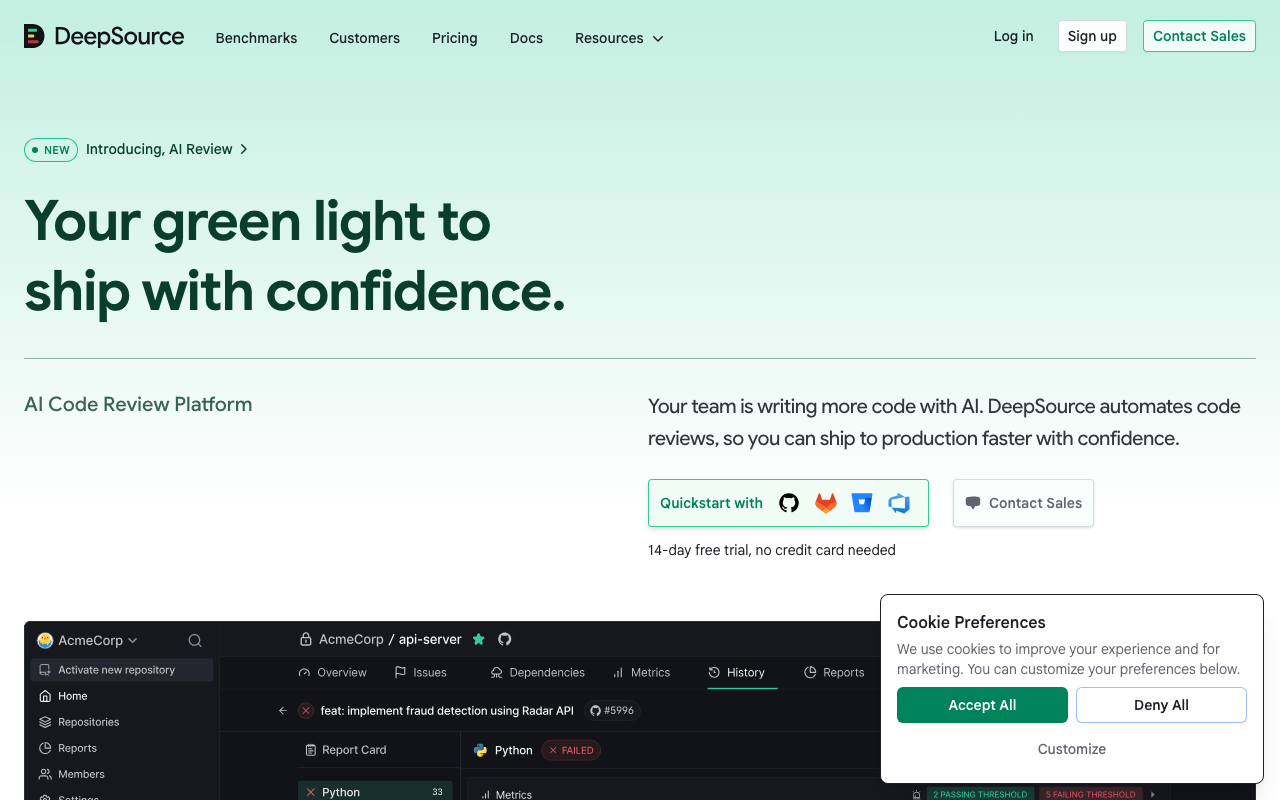
DeepSource is free for open-source organizations and individual developers. The platform offers two free tiers - an Open Source plan for teams working on public repositories and an Individual plan for solo developers. Both provide access to DeepSource’s static analysis engine with 5,000+ rules across 12+ programming languages at zero cost.
However, “free” comes with meaningful boundaries. The Open Source plan does not support private repositories. The Individual plan is limited to a single user. Neither free tier bundles AI Review credits or includes advanced features like monorepo support, audit logs, or API access. Understanding exactly what the free plan includes - and where it falls short - helps you decide whether DeepSource’s free offering is enough for your needs or whether a paid plan or alternative tool makes more sense.
For full pricing details across all tiers, see our DeepSource pricing breakdown.
What DeepSource’s free plans include
DeepSource currently offers two free options as of March 2026. The distinction between them matters because they serve fundamentally different use cases.
Open Source plan
The Open Source plan replaced the former Free plan in February 2026. It is built for open-source organizations and teams whose code lives in public repositories.
Included at no cost:
- Unlimited public repositories
- Unlimited team members
- 1,000 pull request reviews per month
- 1,000 automated code formatting runs per month
- Static analysis with 5,000+ rules
- Support for 12+ languages (Python, JavaScript, TypeScript, Go, Ruby, Java, Rust, C#, Kotlin, PHP, Scala, Swift)
- AI Review and Autofix available on a pay-as-you-go basis
The 1,000 monthly PR review limit is generous for most open-source projects. Even active projects with daily contributions rarely exceed this threshold - a project would need more than 33 PRs per day to hit the cap.
Individual plan
The Individual plan is designed for solo developers working on personal projects. Unlike the Open Source plan, it supports both public and private repositories. However, it is restricted to a single user and provides limited feature access compared to the paid Team plan.
This plan works well for freelancers, solo developers building side projects, or anyone who wants to try DeepSource’s analysis on a private codebase without committing to a subscription.
What the free plan does not include
The free tiers leave out several features that teams and growing projects typically need. These gaps are the primary reasons users upgrade to the Team plan.
Private repository support (Open Source plan). This is the most significant limitation. If your team works on proprietary code in private repos, the Open Source plan simply will not work. The Individual plan supports private repos but only for a single user.
Bundled AI Review credits. Team plan users receive $120 in AI Review credits per year ($10/month per user). Free tier users must pay for AI Review on a pay-as-you-go basis at $8 per 100,000 input tokens. For teams that want AI-powered PR analysis without per-use charges, this is a notable gap.
Unlimited Autofix. On the Team plan, Autofix - the feature that generates one-click code fixes for detected issues - runs with no caps. On the Open Source plan, Autofix is metered on pay-as-you-go pricing.
Monorepo support. Teams using monorepo architectures need the Team plan for proper project-level configuration within a single repository.
Audit logs, API access, and webhooks. Operational features for CI/CD integration, compliance tracking, and data export are exclusively available on paid plans.
Priority support. Free tier users receive standard support. The Team plan provides faster response times through priority support.
OSS dependency scanning. Vulnerability scanning and license compliance for open-source dependencies require a paid subscription.
Free vs Team vs Enterprise comparison
| Feature | Open Source (Free) | Individual (Free) | Team ($24/user/mo) | Enterprise (Custom) |
|---|---|---|---|---|
| Public repos | Unlimited | Unlimited | Unlimited | Unlimited |
| Private repos | No | Yes (1 user) | Unlimited | Unlimited |
| Team members | Unlimited | 1 | Unlimited | Unlimited |
| PR reviews/month | 1,000 | Limited | Unlimited | Unlimited |
| Code formatting/month | 1,000 | Limited | Unlimited | Unlimited |
| Static analysis rules | 5,000+ | 5,000+ | 5,000+ | 5,000+ |
| Languages | 12+ | 12+ | 12+ | 12+ |
| Autofix | Pay-as-you-go | Limited | Unlimited | Unlimited |
| AI Review credits | Pay-as-you-go | Pay-as-you-go | $120/user/year bundled | Custom |
| Monorepo support | No | No | Yes | Yes |
| Audit logs | No | No | Yes | Yes |
| API and webhooks | No | No | Yes | Yes |
| SSO/SCIM | No | No | No | Yes |
| Self-hosted deployment | No | No | No | Yes |
| Priority support | No | No | Yes | Yes (SLA-backed) |
When the free plan is enough
The free tier genuinely works for several common scenarios. You do not need to pay if your situation fits one of these profiles.
Open-source maintainers. If your repositories are public, the Open Source plan provides everything you need for code quality analysis. You get the same 5,000+ rule engine that paid users access, with generous monthly limits on PR reviews and formatting runs. This is one of the strongest free offerings in the code quality space.
Solo developers with side projects. The Individual plan lets you analyze personal projects - including private ones - at no cost. For a single developer learning a new language or building a portfolio project, this is more than sufficient.
Teams evaluating DeepSource. Use the Open Source plan on a public test repository to experience the analysis quality and interface before committing budget. Alternatively, the 14-day free trial of the Team plan (no credit card required, includes $50 in AI Review credits) gives you access to every feature for evaluation.
Small open-source organizations. Groups maintaining multiple public projects can connect all their repositories under the Open Source plan with no limits on repos or team members. The 1,000 monthly PR review cap accommodates most open-source contribution patterns comfortably.
When you should upgrade
Several situations make the free plan insufficient. Recognizing these triggers early saves you from hitting unexpected limits.
Your team works on private code. This is the most common upgrade trigger. Any team with proprietary repositories needs the Team plan at $24/user/month (annual billing). There is no workaround for this limitation on the Open Source plan.
You rely on Autofix for productivity. If Autofix is saving your team significant time by generating one-click fixes for detected issues, the pay-as-you-go metering on the free plan can become unpredictable. The Team plan’s unlimited Autofix removes this concern entirely.
You need CI/CD integration. API access, webhooks, and integration capabilities require the Team plan. If DeepSource needs to fit into your automated development pipeline, the free tier cannot support this.
Your team exceeds comfortable limits. While the Open Source plan’s 1,000 monthly PR reviews work for most projects, very active repositories with multiple contributors submitting PRs daily may approach this ceiling.
Compliance requirements exist. Audit logs and role-based access control are Team plan features. Teams in regulated environments or organizations with compliance obligations will need the paid tier.
For a detailed look at paid plan pricing and ROI calculations, see our complete DeepSource pricing guide.
Free alternatives to DeepSource
If DeepSource’s free tier does not fit your needs - particularly around private repository support - several alternatives offer meaningful free access. For a comprehensive list, see our guide to the best free code review tools.
SonarQube Community Build - free, self-hosted
SonarQube offers a free Community Build that you can self-host with no licensing fees. It supports 30+ languages and includes 5,000+ rules. The trade-off is that you manage the infrastructure yourself, and the Community Build lacks PR decoration, branch analysis, and some advanced security rules. For teams willing to self-host, this is the strongest free option for private repository analysis.
Semgrep - free for up to 10 contributors
Semgrep provides a free tier supporting up to 10 contributors with access to its scanning engine and community rules. The open-source CLI is completely free with no contributor limits for local or CI usage. Semgrep excels at security-focused scanning and custom rule authoring, making it a strong complement or alternative to DeepSource.
CodeRabbit - free AI PR reviews
CodeRabbit offers free AI-powered pull request reviews on both public and private repositories with no contributor limits. If your primary need is AI-driven code review rather than static analysis, CodeRabbit’s free tier is more generous than DeepSource’s. It covers 30+ languages and includes inline comments, PR summaries, and one-click fix suggestions.
Codacy - free for open source
Codacy provides a free tier for open-source projects with IDE-based analysis. The paid plan starts at $18/dev/month, making it slightly cheaper than DeepSource’s Team plan. Codacy supports 40+ languages - significantly more than DeepSource’s 12+.
For a broader comparison, read our DeepSource alternatives guide or our roundup of the best code quality tools.
How Qlty compares
Qlty is the code health platform from the team behind Code Climate, and it is the most direct challenge to DeepSource’s free tier. Rather than running one proprietary analysis engine, Qlty orchestrates 70+ static analysis tools across 40+ languages behind a single configuration file.
Qlty pricing:
- Free: unlimited public and private repositories, unlimited contributors, linting and auto-formatting, 250 analysis minutes per month, full CLI access
- Team: $15/contributor/month - adds 1,000 analysis minutes, maintainability grading, test coverage tracking with PR gates, technical debt quantification, and historical trends
- Enterprise: $36/contributor/month - adds custom quality gates, advanced reporting, and pay-as-you-go overage
The key difference is what the free tier covers. DeepSource’s Open Source plan is public repositories only, so a team with private code gets nothing free. Qlty’s free plan includes private repositories and does not cap contributors - it caps analysis minutes instead, which is a far softer constraint for a small team.
For teams choosing between DeepSource’s paid Team plan and Qlty’s, the trade is signal quality against breadth. DeepSource’s sub-5% false positive rate and mature Autofix are its strongest assets. Qlty at $15/contributor/month is cheaper and covers more languages, but you are assembling results from many underlying linters rather than one tuned engine.
Final recommendation
DeepSource’s free plan is a solid option for open-source projects and individual developers who want quality static analysis without paying anything. The 5,000+ rule engine, 12+ language support, and generous monthly limits make it one of the better free code quality tools available in 2026.
Use the free plan if your repositories are public and your team’s primary need is rule-based static analysis. The Open Source plan delivers genuine value at zero cost for this use case.
Upgrade to Team ($24/user/month) if you have private repositories, need unlimited Autofix, want bundled AI Review credits, or require operational features like audit logs and API access. The 14-day free trial makes evaluation risk-free.
Consider alternatives if you need private repo analysis for free (SonarQube Community Build), AI-powered PR reviews at no cost (CodeRabbit), or free analysis on private repositories (Qlty’s free plan covers unlimited public and private repos).
For an in-depth look at DeepSource’s capabilities beyond pricing, read our DeepSource review.
Further Reading
 Gitar
GitarComments are not enough
Gitar applies the fix, validates it in CI, and clears the queue.
See it on your repo Read our independent Gitar reviewFrequently Asked Questions
Is DeepSource free?
Yes, DeepSource is free for open-source organizations using public repositories and for individual developers. The Open Source plan provides unlimited public repos, unlimited team members, 1,000 PR reviews per month, and static analysis with 5,000+ rules at no cost. Individual developers can also use a free plan for both public and private repositories with limited features.
Is DeepSource free for private repositories?
DeepSource's free Individual plan supports private repositories for a single user. However, the Open Source plan - designed for teams - only covers public repositories. If your team needs to analyze private repos collaboratively, you must upgrade to the Team plan at $24/user/month. There is no free team plan that includes private repository analysis.
What happened to the DeepSource Free plan?
DeepSource deprecated its original Free plan in February 2026 and replaced it with the Open Source plan. The old Free plan supported up to 3 private repos and 3 team members with 500 analysis runs per month. The new Open Source plan removes private repo support and is designed exclusively for open-source organizations. Free plan users were migrated on March 23, 2026.
Does DeepSource have a free trial?
Yes. DeepSource offers a 14-day free trial of the Team plan with no credit card required. The trial includes up to $50 in AI Review credits, unlimited repositories, unlimited Autofix, monorepo support, and all Team plan features. After the trial ends, you can continue on the free Open Source plan or subscribe to Team.
Is DeepSource free for students?
DeepSource does not advertise a dedicated student plan. However, students can use the free Open Source plan for public repositories or the Individual plan for personal projects. Most student projects hosted publicly on GitHub qualify for the Open Source plan with full static analysis at no cost.
How many repositories can I use on DeepSource's free plan?
The Open Source plan supports unlimited public repositories with no caps. The Individual plan supports both public and private repos for a single user with limited features. On either free tier, there is no restriction on the number of repositories you can connect.
Does DeepSource free include AI code review?
AI Review and Autofix are available on the Open Source plan only on a pay-as-you-go basis. They are not bundled for free. Each Team plan user receives $120 in annual AI Review credits as part of their subscription. If you need AI-powered review without paying, consider alternatives like CodeRabbit's free tier.
Is DeepSource free for open-source projects?
Yes. DeepSource's Open Source plan is completely free for open-source organizations with public repositories. It includes unlimited public repos, unlimited team members, 1,000 PR reviews per month, 1,000 code formatting runs per month, and access to 5,000+ static analysis rules. AI features are available on a pay-as-you-go basis.
What are the limits of DeepSource's free plan?
The Open Source plan limits you to public repositories only, caps PR reviews at 1,000 per month and code formatting runs at 1,000 per month, and does not include bundled AI Review credits, monorepo support, audit logs, API access, or priority support. The Individual plan limits you to a single user with restricted feature access.
Can I use DeepSource free for commercial projects?
Only if your commercial project uses public repositories. The Open Source plan requires public repos regardless of whether the project is commercial or not. For proprietary commercial code in private repos, you need the Team plan at $24/user/month. The 14-day free trial lets you evaluate Team plan features before committing.
Is DeepSource better than free alternatives like SonarQube?
DeepSource's free tier is more limited than SonarQube Community Build for teams with private repos because SonarQube's self-hosted option works with any repository at zero license cost. However, DeepSource's analysis quality is higher with a sub-5% false positive rate, and setup is significantly easier since it requires no self-hosting. The right choice depends on whether you prioritize ease of setup or private repo support.
How does DeepSource's free plan compare to Qlty?
DeepSource's free plan covers public repositories only, while Qlty's free plan covers unlimited public and private repositories with unlimited contributors and 250 analysis minutes per month. If you need free analysis on private code, Qlty is the better starting point. DeepSource's advantage is its sub-5% false positive rate and mature Autofix. Qlty's paid Team plan is $15/contributor/month against DeepSource's $24/user/month.
Explore More
Tool Reviews
 DeepSource Review
 Qlty Review
Free Newsletter
Stay ahead with AI dev tools
Weekly insights on AI code review, static analysis, and developer productivity. No spam, unsubscribe anytime.
Join developers getting weekly AI tool insights.
Related Articles
Is CodeRabbit Free for Open Source? Yes - And for Private Repos Too
CodeRabbit's free tier covers unlimited public and private repositories, not just open source. Here is exactly what the free plan includes, where the rate limits bite, and when to pay.
July 31, 2026
guideIs SonarLint Deprecated? No - Here's What Actually Happened
SonarLint was not deprecated. It was renamed to SonarQube for IDE on October 29, 2024, as part of a company-wide rebrand. Here is what changed, what did not, and what to install.
July 31, 2026
guideIs Semgrep Free for Commercial Use? Yes, With Two Catches
Semgrep Community Edition is LGPL-2.1 and free for commercial use. The paid tier is also free up to 10 contributors. Here is where the line actually falls and what you give up.
July 31, 2026