The Complete Guide to AI Code Review
Everything about AI-powered code review: how it works, leading tools, real-world results, limitations, and how to integrate AI reviewers into your workflow.
22 min read
AI code review has moved from an experiment to a standard part of the engineering toolkit. In 2024, fewer than 10% of engineering teams used AI-powered review tools. By early 2026, that number has crossed 40% among teams with more than 10 developers, and the adoption curve is still steepening. The reason is straightforward: AI reviewers provide instant, consistent feedback on every pull request, catching issues that human reviewers miss due to fatigue, time pressure, or unfamiliarity with a particular part of the codebase.
But AI code review is not a single technology. It spans a range of approaches, from PR bots that comment on diffs to IDE assistants that review code as you write it to CLI tools that analyze entire repositories. Understanding how these tools work, where they excel, and where they fail is essential for any team considering adoption.
This chapter covers the complete landscape of AI code review in 2026: the underlying technology, the categories of tools available, real-world results from teams using them, known limitations, and a practical guide for integrating AI review into your workflow. For a broader look at code review fundamentals, see what is AI code review.
How AI Code Review Works
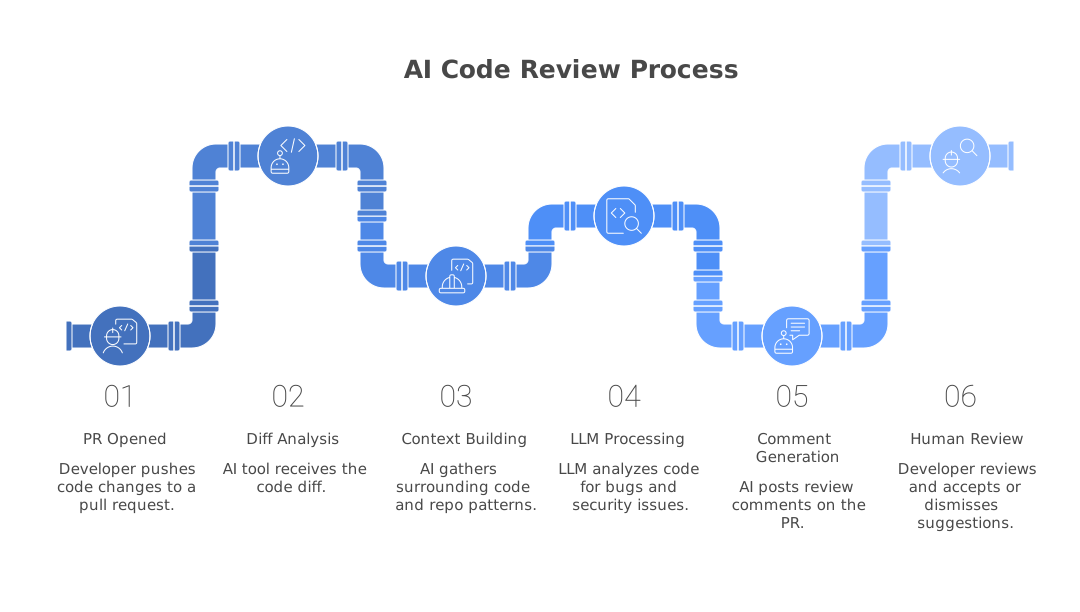
At its core, AI code review uses large language models to read code, understand its intent, and generate feedback. But the implementation details vary significantly across tools, and those details determine the quality of the review.
Diff analysis. Most AI code review tools operate on pull request diffs rather than entire codebases. When a developer opens a PR, the tool receives a webhook containing the changed files. It extracts the diff (the lines added, modified, and removed) and constructs a prompt that includes this diff along with surrounding context from the unchanged portions of the file.
Context windows. The quality of AI review depends heavily on how much context the model can see. Early tools (2023-era) were limited by GPT-3.5’s 4K token context window, which meant they could only review small diffs in isolation. Modern tools leverage models with 128K-200K token windows (GPT-4o, Claude 3.5/4, Gemini 2.5), allowing them to analyze large diffs with full file context. The best tools go further, pulling in related files, type definitions, test files, and repository-specific documentation to give the model a richer understanding of the change.
Prompt engineering. The prompt is where the tool’s intelligence lives. A naive prompt (“review this code”) produces generic, unhelpful feedback. Production-grade tools construct prompts that include:
- The diff with line numbers and file paths
- The full content of changed files (not just the diff)
- Related files that import or are imported by the changed code
- Repository-specific review guidelines (often configured by the team)
- The PR description and any linked issues
- Previous review comments and conversations on the same PR
Model selection. Different tools use different models. Some use OpenAI’s GPT-4o or GPT-4.1, others use Anthropic’s Claude, and some use fine-tuned models trained specifically on code review data. The model choice affects the quality, speed, and cost of the review. Fine-tuned models tend to produce fewer false positives for common patterns, while general-purpose frontier models handle novel or unusual code better.
Post-processing. Raw LLM output is not directly usable as PR comments. Tools parse the model’s response, map findings back to specific lines in the diff, categorize issues by severity, filter out low-confidence findings, and format the output as inline review comments on the PR platform (GitHub, GitLab, Bitbucket, or Azure DevOps).
The Evolution of AI Code Review (2023-2026)
AI code review has evolved rapidly over three years, and understanding this trajectory helps explain why tools that felt gimmicky in 2023 have become genuinely useful in 2026.
2023: The proof-of-concept era. The first wave of AI code review tools appeared after GPT-4’s release in March 2023. Tools like CodeRabbit, Sourcery, and early versions of PR-Agent demonstrated that LLMs could produce meaningful code review feedback. But context windows were small (4K-8K tokens), models hallucinated frequently, and false positive rates were high enough (40-60%) that many developers dismissed AI review as noise. The tools were impressive demos but not yet reliable enough for production workflows.
2024: Context and accuracy improvements. The second wave was driven by larger context windows (128K+ tokens), better models (GPT-4o, Claude 3.5 Sonnet), and smarter prompt engineering. Tools began pulling in cross-file context, learning from repository-specific patterns, and offering configuration options that let teams tune the review focus. False positive rates dropped to 15-30% for well-configured tools. GitHub launched Copilot code review in preview. This was the year AI code review crossed from “interesting experiment” to “genuinely useful for many teams.”
2025: Integration and specialization. The third wave brought deeper integration with development workflows. AI reviewers began understanding not just individual PRs but the broader context of the codebase, including its architecture, coding conventions, and historical patterns. Specialized tools emerged for security review, performance analysis, and test generation. The open-source ecosystem matured, with PR-Agent offering a production-grade self-hosted option. Enterprise adoption accelerated as tools achieved SOC 2 compliance and offered on-premises deployment.
2026: The current state. AI code review in 2026 is characterized by multi-model architectures (tools that use different models for different tasks), agentic workflows (AI that can run tests, check documentation, and verify fixes), and deep IDE integration. The best tools now catch 30-60% of the issues a human reviewer would find, with false positive rates under 15% when properly configured. AI review has become the first pass in the review process for a growing number of teams, with human reviewers focusing on architecture, business logic, and mentoring. For a comprehensive look at the current landscape, see our state of AI code review in 2026.
Categories of AI Code Review Tools
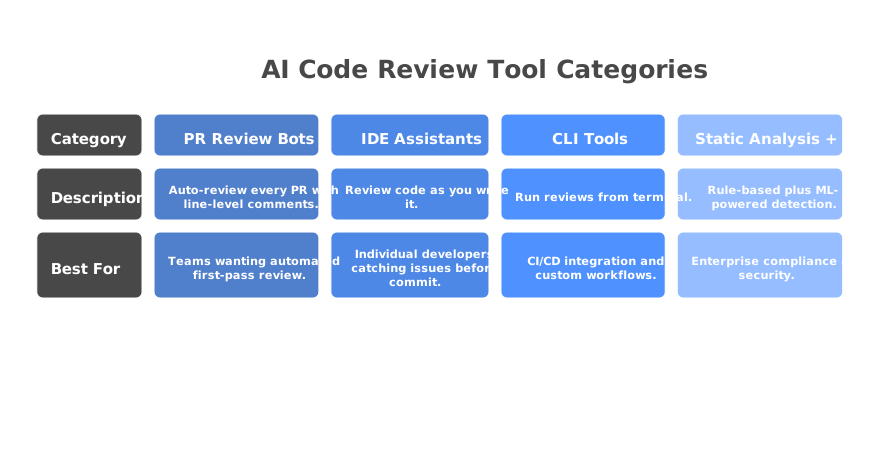
AI code review tools fall into four broad categories, each serving a different part of the development workflow.
PR bots
PR bots are the most common category. They install as GitHub/GitLab/Bitbucket apps, trigger automatically when a PR is opened or updated, and post review comments directly on the PR. The developer experience is seamless because the AI review appears alongside human reviews in the same interface.
Examples: CodeRabbit, Greptile, PR-Agent, Cursor BugBot, Ellipsis
Strengths: Zero friction, automatic triggering, visible to the whole team, integrated into the existing PR workflow.
Weaknesses: Limited to PR-level review (cannot review code before it is committed), dependent on the PR platform’s API and comment format.
IDE assistants
IDE assistants review code as you write it, providing feedback before you even open a PR. They run inside VS Code, JetBrains IDEs, or other editors and can flag issues in real time.
Examples: GitHub Copilot, Gemini Code Assist, Claude Code
Strengths: Fastest feedback loop (immediate), catches issues before they enter the codebase, can suggest fixes inline.
Weaknesses: Review quality depends on the local context available to the IDE, cannot see the full PR diff or cross-file changes, feedback is private to the developer rather than visible to the team.
CLI tools
CLI tools run from the terminal and can analyze individual files, directories, or entire repositories. They are useful for pre-commit review, batch analysis, and integration into custom automation pipelines.
Examples: Claude Code, Greptile (via API)
Strengths: Flexible, scriptable, can analyze code outside of the PR workflow, useful for repository-wide audits.
Weaknesses: Requires manual invocation (or scripting), output format varies, less integrated into the team review workflow.
Static analysis + AI hybrids
These tools combine traditional rule-based static analysis with AI-powered analysis, using each approach where it is strongest. Rules handle deterministic checks; AI handles semantic understanding and natural-language feedback.
Examples: DeepSource, SonarQube (with AI features), Codacy, Semgrep (with Semgrep Assistant)
Strengths: You get the best of both worlds: deterministic rules for known patterns and AI for novel issues. This typically means lower false positive rates than pure AI tools.
Weaknesses: More complex to configure, may require separate setup for the AI and rule-based components.
Leading AI Code Review Tools in 2026
Here is a brief overview of the tools that stand out in 2026. For in-depth comparisons, pricing, and testing results, see our full guide to the best AI code review tools.
CodeRabbit remains the most widely adopted AI PR review tool, with over 2 million connected repositories. It provides line-by-line review comments, PR summaries, sequence diagrams, and supports natural-language instructions for customizing review behavior. Its free tier covers unlimited public and private repositories.
Greptile indexes your entire repository rather than reading the diff alone, which lets it flag changes that conflict with conventions or callers elsewhere in the codebase. It attaches confidence scores to its comments so teams can tune how much noise reaches the PR. It integrates with GitHub and GitLab, and starts at $30/developer/month.
PR-Agent by Qodo is the leading open-source AI code review tool. It can be self-hosted with your own OpenAI, Anthropic, or other LLM API keys, giving teams full control over data privacy. It supports commands like /review, /describe, /improve, and /test directly from PR comments.
Cursor BugBot focuses on finding actual bugs rather than style issues. Built by the team behind the Cursor IDE, it uses multi-step reasoning to trace code paths and identify logic errors, null pointer risks, and concurrency issues.
Gemini Code Assist is Google’s AI code review offering, integrated into the Google Cloud ecosystem. It provides PR review via GitHub and GitLab integration, with strong performance on Go, Java, Python, and TypeScript codebases. Its million-token context window allows it to analyze very large PRs.
Claude Code from Anthropic operates as both a CLI tool and an IDE assistant. It can review code in-editor, analyze diffs from the command line, and is increasingly used for pre-commit review. Its strength lies in nuanced, natural-language explanations of complex code issues.
Real-World Results: What Teams Report
Vendor marketing claims are easy to find. Independent results from real teams are harder to come by but more useful. Here is what engineering teams report after 6-12 months of AI code review adoption:
Review cycle time reduction. Teams consistently report 30-50% reductions in the time from PR opened to PR merged. The primary driver is not that AI finds more bugs. Rather, AI provides instant first-pass feedback, so the human reviewer starts from a cleaner baseline. The author often fixes AI-flagged issues before the human reviewer even begins.
Defect detection. AI tools catch categories of bugs that human reviewers commonly miss: null pointer risks in edge cases, missing error handling on async operations, incorrect error propagation, and resource leaks. Teams report catching 5-15 additional production-bound bugs per month that would have slipped through human-only review.
Review workload distribution. In teams without AI review, a small number of senior engineers typically handle a disproportionate share of reviews. AI review reduces the burden on these individuals by handling the first pass, allowing them to focus on the issues that genuinely require their expertise.
Developer satisfaction. Engineers report higher satisfaction with the review process when AI handles mechanical checks. Reviewers appreciate being able to focus on design and architecture rather than pointing out missing null checks for the hundredth time. Authors appreciate getting immediate feedback rather than waiting 24+ hours for a human review.
Onboarding acceleration. New team members get immediate, consistent feedback on every PR from the AI reviewer, which supplements (but does not replace) the mentoring they receive from human reviewers. Several teams report that new hires reach full productivity 2-4 weeks faster with AI review in place.
For a deeper analysis including data from multiple industry surveys, see our article on AI code review vs. manual review.
Limitations and Failure Modes
AI code review is genuinely useful, but it has real limitations that teams need to understand before adoption.
Business logic blindness. AI reviewers can check whether code is syntactically correct, handles errors properly, and follows common patterns. They cannot check whether the code implements the correct business logic. An AI tool will not flag that your discount calculation uses multiplication when it should use addition, unless the bug is so obvious that a pattern match would catch it anyway.
Architectural reasoning. AI tools operate primarily at the file and diff level. They struggle with architectural questions: “Should this service call that service directly or go through a message queue?” “Does this new endpoint belong in this microservice or should it be in a different one?” These decisions require understanding the system’s history, its scaling requirements, and the team’s operational capabilities.
False positives. Even the best AI tools produce false positives at rates of 10-20%. Over hundreds of PRs, this adds up. A tool that produces 3 false positives per PR review across a team that opens 20 PRs per day generates 60 incorrect findings daily. If these are not suppressed quickly, developers learn to ignore the tool entirely.
Inconsistency. Unlike static analysis, AI review is non-deterministic. The same code reviewed twice may receive different feedback. This can be confusing for developers and makes it difficult to establish consistent team standards through AI review alone.
Context limitations. Despite larger context windows, AI tools still cannot reason about the entire codebase simultaneously. They may miss issues that require understanding distant parts of the system. For example, a change to a data model might break an assumption in a reporting module three layers away.
Hallucinated APIs and patterns. LLMs occasionally suggest code fixes that reference APIs or patterns that do not exist. A model might suggest using a library function with the wrong signature or recommend a design pattern that does not fit the framework in use. Human reviewers need to verify AI suggestions, not accept them blindly.
To read more about this topic, see our analysis of whether AI is replacing code reviewers. The short answer is that it is augmenting them, not replacing them.
Privacy and Security Considerations
When you use an AI code review tool, your source code is sent to an LLM for analysis. For many teams, this raises legitimate security and compliance concerns.
Data transmission. Most AI review tools send code to external LLM providers (OpenAI, Anthropic, Google) for processing. This means your proprietary source code leaves your infrastructure. Even if the LLM provider’s terms of service prohibit training on customer data, the code still transits through their servers.
Compliance requirements. Teams subject to SOC 2, HIPAA, PCI-DSS, or FedRAMP requirements need to verify that their AI review tool’s data handling meets their compliance framework. Look for tools that publish SOC 2 Type II reports and have clear data processing agreements.
Self-hosted options. For teams with strict data sovereignty requirements, self-hosted AI review is the safest option. PR-Agent can be deployed on your own infrastructure with your own LLM API keys or even with locally hosted models. This keeps code within your network perimeter while still benefiting from AI review.
Data retention. Ask every vendor: How long do you store code after review? Is it stored encrypted? Can it be deleted on request? The answers vary significantly. Some tools store code only for the duration of the review (minutes), while others retain it for caching, analytics, or model improvement purposes.
Access controls. Verify that the tool’s GitHub/GitLab integration follows the principle of least privilege. It should only request access to the repositories you explicitly authorize, not your entire organization. Review the OAuth scopes and permissions before installation.
For enterprise teams evaluating AI code review, our guide on AI code review for enterprise covers compliance, procurement, and deployment considerations in depth.
Integrating AI Review Into Your Workflow
Setting up AI code review is straightforward for most tools. Here is a practical guide for integrating it into a GitHub-based workflow.
Step 1: Choose your tool. For most teams, start with a PR bot because it has the lowest friction and the highest visibility. CodeRabbit is a safe default for its free tier and broad language support. If you need reviews that reason about the whole codebase rather than the diff, consider Greptile. If data privacy is your top priority, deploy PR-Agent on your own infrastructure.
Step 2: Install and configure. Most PR bots install as a GitHub App in under five minutes. After installation, create a configuration file in your repository root to customize the review behavior:
# .coderabbit.yaml (example for CodeRabbit)
reviews:
  auto_review:
    enabled: true
    drafts: false
  path_instructions:
    - path: "src/api/**"
      instructions: "Focus on input validation, error handling, and authentication checks. Flag any endpoint that does not validate request parameters."
    - path: "src/database/**"
      instructions: "Check for SQL injection risks, missing transactions, and N+1 query patterns."
    - path: "tests/**"
      instructions: "Verify test coverage for edge cases. Suggest additional test cases for error paths."
Step 3: Establish team norms. Communicate to your team how to interact with AI review comments. Recommended norms:
- Treat AI comments as suggestions, not mandates. Human reviewers have the final say
- Use the AI tool’s reaction features (thumbs up/down) to provide feedback that improves future reviews
- If an AI comment is a false positive, dismiss it with a brief explanation so the team knows it was evaluated
- Do not wait for AI review to complete before starting human review, since they run in parallel
Step 4: Layer with existing automation. AI review should complement, not replace, your existing automation. Keep your linting, formatting, testing, and static analysis CI checks in place. AI review catches a different category of issues than rule-based tools. The combination is stronger than either alone. For a detailed walkthrough of building a complete automation stack, see how to automate code review.
Step 5: Measure and iterate. After 30 days, review the AI tool’s impact:
- How many AI comments led to code changes? (This is your signal-to-noise ratio)
- Has review cycle time decreased?
- Are there categories of false positives that should be suppressed?
- Do developers find the tool helpful or annoying?
Use these signals to tune your configuration, adjust path-specific instructions, and decide whether to expand or reduce the tool’s scope.
AI + Human: The Hybrid Review Model
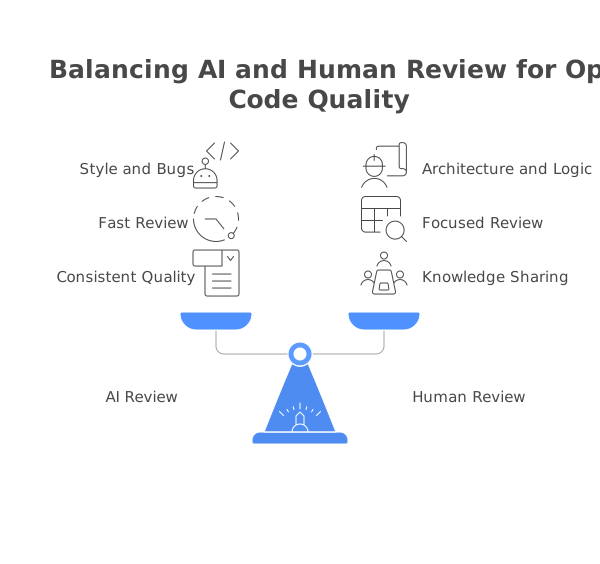
The most effective code review processes in 2026 use a hybrid model: AI handles the first pass, and humans handle the second.
Here is how it works in practice:
- Developer opens a PR. The AI review tool triggers automatically and posts its review within 2-5 minutes.
- Developer addresses AI feedback. Before the human reviewer even begins, the author fixes the straightforward issues flagged by the AI, like missing error handling, potential null references, and style inconsistencies. This takes 5-15 minutes.
- Developer pushes fixes. The AI re-reviews the updated diff and confirms the fixes or flags new issues.
- Human reviewer begins. The human reviewer now sees a cleaner diff. The trivial issues have been resolved. The reviewer can focus on design, architecture, business logic, and mentoring.
- Human and AI feedback converge. The human reviewer may agree with some remaining AI comments, disagree with others, and add their own higher-level feedback. The author addresses all feedback and the PR merges.
This model works because AI and human reviewers have complementary strengths:
| Capability | AI Reviewer | Human Reviewer |
|---|---|---|
| Speed | 2-5 minutes | 2-24 hours |
| Consistency | Identical rigor every time | Varies by reviewer, time of day |
| Pattern detection | Excellent for known patterns | Good but affected by fatigue |
| Business logic | Cannot evaluate | Essential strength |
| Architecture | Limited to file-level | Understands system-wide context |
| Mentoring | Generic suggestions | Tailored to the individual |
| Security patterns | Strong for common vulnerabilities | Catches novel attack vectors |
| Availability | 24/7, every PR | Limited by reviewer availability |
The hybrid model does not just improve review quality. It also improves the reviewer’s experience. When a senior engineer sits down to review a PR and finds that formatting, null checks, error handling, and basic security patterns have already been addressed, they can spend their time on the work that is genuinely interesting and impactful: evaluating design decisions, questioning architectural choices, and helping the author think through trade-offs.
The Future of AI Code Review
AI code review is evolving fast. Several trends are shaping where the technology is headed over the next 12-24 months.
Agentic review. Current AI reviewers read code and leave comments. The next generation will take actions: running tests to verify their suggestions, checking documentation for consistency with code changes, creating follow-up issues for tech debt they identify, and even generating fix PRs for straightforward bugs. Some tools, including Claude Code, are already moving in this direction.
Codebase-aware review. Today’s tools primarily analyze individual PRs. Future tools will maintain a persistent understanding of the entire codebase, including its architecture, coding patterns, historical decisions, and domain-specific conventions. This will enable feedback like “this pattern contradicts the approach used in the payments module” rather than generic best-practice suggestions.
Personalized review. AI reviewers will adapt to individual developers’ experience levels and learning goals. A senior engineer might receive only high-severity findings, while a junior developer receives detailed explanations and learning resources alongside each finding.
Multi-model pipelines. Instead of using a single LLM for all review tasks, tools will route different aspects of review to specialized models: one for security analysis, another for performance, and a third for readability and documentation. This already exists in embryonic form and will become the standard architecture.
Review as conversation. Current AI review is largely one-directional: the tool posts comments and the developer reads them. Future tools will support genuine back-and-forth discussion, where a developer can ask “why is this a problem?” or “what would you suggest instead?” and receive contextual, informed responses. PR-Agent already supports this to a degree through its slash commands, and it will become more natural and capable.
The trajectory is clear: AI code review is becoming more capable, more contextual, and more deeply integrated into the development workflow. Teams that adopt it now and learn to use it effectively will have a meaningful advantage in development velocity and code quality. Teams that wait will eventually adopt it anyway, but they will be catching up rather than leading.
The key takeaway is not to treat AI code review as a replacement for anything. It is a new capability that makes your existing review process better. Start with a single tool, measure its impact, tune its configuration, and expand from there. The best code review process is one where machines handle what machines do best and humans handle what humans do best. AI code review brings that vision closer to reality than ever before.
Frequently Asked Questions
Can AI replace human code reviewers?
Not entirely. AI excels at catching bugs, security issues, style violations, and suggesting improvements at scale. But it can't fully evaluate business logic correctness, architectural fit, or team-specific conventions. The best approach is AI + human review, where AI handles the mechanical checks so humans can focus on design and mentoring.
Which AI code review tool is best in 2026?
It depends on your needs. CodeRabbit and Greptile lead for PR-level review with deep context. PR-Agent (open-source) is great for teams wanting self-hosted control. Cursor BugBot excels at IDE-integrated review. See our full comparison of the best AI code review tools for detailed rankings.
Is AI code review secure? Does it see my code?
Most AI review tools send code to external LLM providers, which raises data privacy concerns. Look for tools with SOC 2 compliance, self-hosted options, or on-device processing. Some tools like PR-Agent can be self-hosted with your own LLM. Always check the vendor's data retention and privacy policies.
How accurate is AI code review?
Modern AI code review tools catch 30-60% of the issues a human reviewer would find, with false positive rates of 10-30% depending on the tool and codebase. They're most accurate for common patterns (null checks, error handling, security anti-patterns) and less reliable for domain-specific business logic.
Continue Learning
Tool Reviews
 CodeRabbit Review
 Greptile Review
 PR-Agent Review
 Cursor BugBot Review
 Gemini Code Assist Review
 Claude Code Review
Newsletter
Stay ahead with AI dev tools
Weekly insights, no spam.