Code Review at Scale
How to scale code review across large teams by tackling bottlenecks, establishing standards, managing reviewer load, and leveraging automation.
18 min read
When Code Review Becomes a Bottleneck
Code review works beautifully on a team of five. There are enough reviewers to provide prompt feedback, everyone knows the codebase, and context switching is minimal. Then the team grows to 20. Then 50. Then 200. And the practice that once made the team faster starts making it slower.
The symptoms are predictable. Pull requests sit open for days waiting for review. Senior engineers spend more time reviewing code than writing it. Developers stack up blocked PRs, context-switch to other work, and lose the mental model of what they were building. Merge conflicts accumulate as PRs age. Eventually, frustrated developers start rubber-stamping reviews just to unblock their colleagues, and the quality benefits of code review evaporate.
This is not a theoretical problem. A 2025 survey by LinearB found that the average PR wait time across their customer base was 28 hours, more than a full business day. For organizations with over 200 developers, the average climbed to 42 hours. Engineering teams reported that review bottlenecks were the single largest source of developer frustration, ahead of flaky tests, unclear requirements, and on-call burden.
The root cause is almost always the same: review load concentrates on a small number of people. In a typical 50-person engineering organization, five to eight senior engineers handle 60-70% of all reviews. They are the code owners, the domain experts, the people whose approval everyone needs. Their calendars fill with review requests, and each additional developer hired makes the bottleneck worse, not better.
Scaling code review is not about doing less review. It is about restructuring who reviews, what they review, and how much of the review process can be automated so that human attention is spent where it matters most. The rest of this chapter covers the patterns, tools, and organizational strategies that make this work. For specific tactics on reducing review cycle time, see our guide to reducing code review time.
Patterns from Big Tech
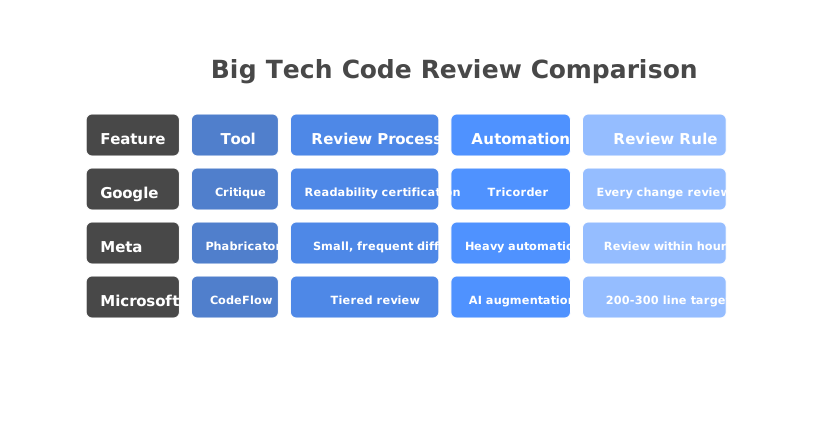
The companies that have scaled code review most successfully are also the ones that have been doing it the longest. Their approaches are different in implementation but share common principles.
Google: Critique and Readability
Google reviews every code change before it merges. At Google’s scale (over 30,000 engineers, tens of thousands of changes per day), this only works because of heavy investment in tooling and process.
Critique is Google’s internal code review tool. Unlike GitHub’s pull request interface, Critique is designed around the assumption that reviews happen continuously, not in batches. It surfaces relevant changes to potential reviewers automatically, provides inline analyzer results (from their Tricorder analysis platform), and tracks review velocity metrics.
Readability is Google’s system for ensuring code quality by language. Before an engineer can approve changes in a given language, they must earn “readability,” a certification achieved by submitting a series of small, clean changes that are reviewed by language experts. This distributes review competence systematically rather than concentrating it in the developers who happened to join first.
Key takeaways for your team: Invest in review tooling that reduces friction. Make reviewer qualification explicit rather than implicit. Track review velocity as a first-class engineering metric.
Meta: Phabricator and Diff Culture
Meta’s engineering culture historically centered on Phabricator (now largely replaced by internal tooling) and a “diff” workflow. Engineers submit diffs (the equivalent of small PRs), and the culture strongly favors small, incremental changes that can be reviewed in minutes rather than hours.
Meta’s approach emphasizes review speed over review depth. The expectation is that most diffs receive feedback within hours, not days. Automated tooling handles style, type checking, and basic correctness, leaving human reviewers to focus on logic and architecture.
Key takeaways for your team: Culture matters as much as tooling. If your organization normalizes multi-day review turnarounds, no tool will fix the problem. Set explicit expectations for review speed.
Microsoft: CodeFlow and Scale Through Structure
Microsoft’s CodeFlow (and its successor tools) approaches scale through structure. Large product teams have formal review policies that vary by risk level. A one-line configuration change has different review requirements than a new authentication module.
Microsoft also pioneered the concept of tiered review, where changes are classified by risk and routed to appropriate reviewers. Low-risk changes (documentation, test updates, minor refactors) need one approval from any team member. High-risk changes (security, API contracts, database schema) require approval from specific senior engineers or architects.
Key takeaways for your team: Not all changes deserve the same review rigor. Classify changes by risk and route accordingly.
Establishing Review Standards and Guidelines
At scale, implicit conventions break down. What is obvious to a five-person team (what “good” feedback looks like, when to block a merge versus leave a suggestion, how quickly reviews should happen) becomes ambiguous when 50 people with different backgrounds and expectations participate in the process.
Written review guidelines are the foundation of scaled code review. They should cover:
What reviewers should look for, organized by priority. A common framework:
- Correctness: Does the code do what the PR description claims?
- Security: Are there input validation, authorization, or data exposure issues? (See Chapter 9: Security-Focused Code Review for a detailed checklist.)
- Performance: Are there obvious performance problems (N+1 queries, unnecessary allocations, missing indexes)?
- Readability: Is the code clear enough for a new team member to understand?
- Maintainability: Is the code structured for future modification?
What reviewers should not look for. Explicitly state that style, formatting, and import ordering are handled by automated tools (linters, formatters) and should not be the subject of review comments. This single guideline eliminates a significant fraction of low-value review friction.
How to provide feedback. Establish conventions for comment types:
- Blocking (must fix before merge): Prefix with
[blocking]or use the “Request changes” feature. - Suggestion (recommended but not required): Prefix with
[nit]or[suggestion]. - Question (seeking understanding): Prefix with
[question].
Turnaround expectations. Set an SLA. A common standard is first response within one business day, with a stretch goal of four hours. Make the SLA visible, and teams using LinearB or CodeScene can track review turnaround on dashboards.
PR size limits. Establish a soft maximum (400 lines is a well-supported threshold from SmartBear and Google research) and provide tooling to help authors stay within it. Graphite enables stacked PRs that break large changes into reviewable increments.
Publish these guidelines in your engineering handbook, link them from your PR template, and revisit them quarterly. Guidelines that are written once and forgotten become artifacts, not practices.
Managing Reviewer Load
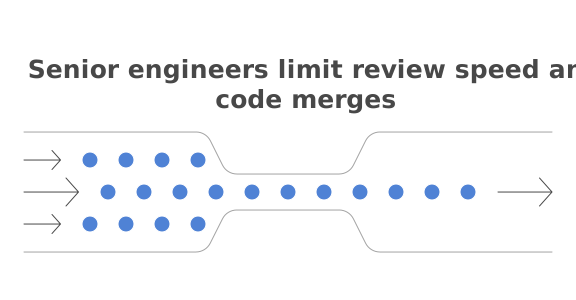
Even with clear guidelines, reviewer load management is the operational challenge that determines whether code review scales or collapses.
CODEOWNERS
GitHub’s CODEOWNERS file (and equivalents in GitLab and Bitbucket) automatically assigns reviewers based on which files a PR touches. This is powerful but dangerous at scale. A CODEOWNERS file that routes all backend changes to the same three engineers creates the exact bottleneck you are trying to avoid.
Effective CODEOWNERS at scale follows these principles:
- Use team handles, not individual names.
@backend-teaminstead of@alice @bob @charlie. Let the team distribute internally. - Keep ownership granular. Own specific directories or modules, not broad swaths of the codebase.
/src/auth/*should have a different owner than/src/billing/*. - Review and rebalance quarterly. As the team grows and code evolves, ownership should shift. Use CodeScene to identify knowledge distribution and ensure ownership reflects actual expertise, not historical accident.
- Require one from the owning team, not all. Configure branch protection to require one approval from the designated team, not approval from every listed owner.
Reviewer Rotation
Rotation systems prevent burnout and distribute knowledge. Two common approaches:
Round-robin assignment. Each PR is assigned to the next reviewer in the rotation. Simple to implement (GitHub Actions or tools like PullApprove support this natively) and ensures even distribution. The downside is that reviewers may lack context for the specific change.
Expertise-weighted rotation. Assign reviewers based on familiarity with the changed files, but rotate among all qualified reviewers. CodeScene provides “knowledge maps” that identify which developers understand which parts of the codebase, enabling intelligent rotation that balances load with expertise.
Review SLAs
An SLA without enforcement is a suggestion. Make review turnaround visible by:
- Adding review wait time to your engineering dashboard (tools like LinearB track this automatically)
- Setting up Slack or Teams notifications when a PR has been waiting longer than the SLA threshold
- Including review turnaround in sprint retrospectives
- Recognizing consistently fast reviewers, not just prolific code authors
The goal is not to pressure reviewers into hasty approvals. It is to make review latency a visible, measured metric that the organization actively manages, the same way it manages deployment frequency or incident response time.
The Role of Automation at Scale
Automation is the primary lever for scaling code review. Every check that can be performed by a machine is a check that a human reviewer does not need to spend attention on.
Linters and formatters. Tools like ESLint, Prettier, Black, and gofmt should run as CI checks and enforce style automatically. Configure them as required checks that block merge on failure. This eliminates all style-related review comments, which studies have shown account for 15-30% of review feedback in teams without automated formatting.
Type checking. TypeScript, mypy, and equivalent tools catch entire classes of bugs (null reference errors, type mismatches, missing fields) that would otherwise require reviewer attention. Run them in CI.
Test coverage gates. Configure your CI pipeline to report coverage changes and optionally block merges that decrease coverage. This ensures test coverage discussions happen with data, not opinions.
Automated dependency checks. Tools like Dependabot, Renovate, and Snyk flag known vulnerabilities in dependencies without human review. For dependency update PRs, consider auto-merging patch-level updates that pass all tests.
Static analysis. SonarQube, Semgrep, and Codacy catch bugs, code smells, and security vulnerabilities at the pattern level. Run these as CI checks so that reviewers see the findings inline with the PR, pre-filtered for their attention.
The compound effect is significant. A team that automates style, types, coverage, dependencies, and static analysis eliminates 40-60% of the issues that human reviewers would otherwise need to catch. The remaining review bandwidth focuses on correctness, architecture, and business logic, which are the areas where human judgment is irreplaceable. For more on building an automated review pipeline, see our guide to automating code review.
AI Review as a Force Multiplier
AI-powered code review tools represent the next step beyond traditional automation. While linters and SAST tools catch known patterns, AI reviewers understand code semantically and can provide feedback that approaches human-level reasoning.
At scale, AI review solves two problems simultaneously:
Immediate first-pass feedback. When a developer opens a PR at 4 PM, they no longer wait until tomorrow for initial feedback. AI tools like CodeRabbit and Greptile analyze the PR within minutes and post comments covering correctness issues, potential bugs, security concerns, and performance problems. The developer can address these before a human reviewer even opens the PR, reducing review round-trips.
Consistent review quality. Human reviewers vary. A senior engineer reviewing their fifth PR of the day provides less thorough feedback than the same engineer reviewing their first PR in the morning. AI review provides consistent, baseline-level feedback on every PR regardless of time of day, reviewer fatigue, or organizational dynamics.
The data supports the impact. Teams adopting AI review tools report a 30-50% reduction in review cycle time, primarily driven by fewer review round-trips. When the first round of automated feedback catches the obvious issues, human reviewers can approve more PRs on the first pass. For a detailed look at how enterprise teams are using AI review, see our enterprise AI code review guide.
However, AI review is a supplement, not a replacement. AI tools in 2026 cannot reliably evaluate architectural decisions, verify that business requirements are correctly implemented, or provide the mentorship value that comes from a senior engineer explaining why a particular approach is problematic. The most effective pattern uses AI for breadth (every PR gets automated feedback) and humans for depth (critical changes get focused expert review).
Tools worth evaluating for scaled review:
- CodeRabbit: Full-PR analysis with contextual comments and automated fix suggestions
- Greptile: Indexes the whole repository so comments reflect codebase context, not just the diff
- Graphite: Stacked PR workflow with AI-assisted review
- GitHub Copilot: Native code review integration within GitHub
Monorepo vs Multi-Repo Review Strategies
Repository structure has a direct impact on how code review scales. The two dominant approaches, monorepo and multi-repo, create different review dynamics.
Monorepo Review
In a monorepo (used by Google, Meta, and increasingly by mid-size companies using tools like Nx and Turborepo), all code lives in a single repository. This simplifies cross-cutting changes because a library update and all its consumers can be updated in a single PR with a single review.
But monorepo review has scaling challenges. A change to a shared library can trigger CODEOWNERS rules for dozens of teams. Without careful configuration, a single PR requires approvals from multiple teams, creating coordination overhead that delays merges for days.
Best practices for monorepo review:
- Use path-scoped ownership (
/libs/auth/*,/apps/web/*) rather than repository-level ownership - Configure required reviewers per path, not per PR. A PR touching
/apps/web/and/libs/auth/needs one reviewer from each team, not one reviewer who knows both - Use build graph tools (Nx, Bazel, Turborepo) to determine the blast radius of a change and scope review accordingly
- Set up automated change impact analysis that labels PRs by risk level based on what they touch
Multi-Repo Review
In a multi-repo setup, each service or library has its own repository. Review is naturally scoped, since each repo has its own CODEOWNERS, its own CI pipeline, and its own review culture. This works well when services are genuinely independent.
The challenge emerges with cross-service changes. Updating an API contract requires coordinated PRs across multiple repositories, and the review of each PR in isolation misses the cross-service implications. Reviewers in Service A may not understand why a particular field was added to the API response because the consuming change lives in Service B’s repository.
Best practices for multi-repo review:
- Use linked PRs (most platforms support cross-repo references) so reviewers can see the full context
- Establish API contract review as a distinct process with its own reviewers who understand both sides
- Consider RFC documents for cross-service changes that describe the full picture before implementation begins
Cross-Team and Cross-Timezone Reviews
Global engineering organizations face a unique review challenge: the author and reviewer may be 8-12 hours apart. A developer in Bangalore opens a PR at 5 PM IST, and the only qualified reviewer is in San Francisco, where it is 3:30 AM.
Without deliberate process, timezone differences add a full day to every review cycle. A PR opened on Monday afternoon in Asia gets first feedback Tuesday morning in the US, the author responds Wednesday morning in Asia, and the review cycle spans three calendar days for a change that needed 20 minutes of actual review.
Strategies for cross-timezone review:
Overlap hours. Identify the window where both timezones are in working hours and schedule synchronous review sessions during that window. Even a two-hour overlap enables rapid iteration.
Timezone-aware reviewer assignment. Route PRs to reviewers in the same or adjacent timezone when possible. If your backend team has members in both London and San Francisco, configure CODEOWNERS or reviewer rotation to prefer same-timezone assignment.
Asynchronous-first review culture. Write PR descriptions that are thorough enough for a reviewer to understand the full context without asking clarifying questions. Include the why (motivation), the what (summary of changes), the how (approach taken and alternatives considered), and the testing (what was verified and how). Every clarifying question that requires a round-trip across timezones adds a day to the review cycle.
AI as a timezone bridge. AI review tools provide immediate feedback regardless of when the PR is opened. A developer in Asia gets automated feedback within minutes, addresses the obvious issues, and the PR is in better shape by the time the US-based reviewer starts their day. This turns a three-day cycle into a two-day cycle, or even a one-day cycle if the automated feedback is comprehensive enough.
Building a Review Culture That Scales
Process and tooling create the conditions for scaled code review, but culture determines whether the system actually works. A team with perfect CODEOWNERS configuration, AI review tools, and SLA dashboards will still fail if the underlying culture treats review as a chore rather than a core engineering practice.
Culture at scale is built through:
Leadership modeling. Engineering leaders who participate in code review signal that review is valued at every level. And this means more than just approving changes to unblock the team; it means providing thoughtful, educational feedback. When a VP of Engineering writes a detailed review comment explaining a concurrency concern, it carries more cultural weight than any written guideline.
Recognition and incentives. Most engineering organizations recognize developers for shipping features. Few recognize developers for excellent review work. Rebalance this. Track review contributions in performance reviews. Highlight particularly insightful review comments in team channels. Make “great reviewer” a compliment as meaningful as “great engineer.”
Onboarding integration. New engineers should participate in code review from their first week, initially as observers and quickly as active reviewers of small changes. This is how they learn team conventions, architectural patterns, and the codebase itself. A new engineer reviewing code learns faster than a new engineer only reading documentation.
Retrospective feedback loops. Periodically (quarterly is sufficient), review the review process itself. Ask: Are review turnaround times meeting the SLA? Are developers satisfied with the quality of feedback they receive? Is reviewer load distributed fairly? Are there recurring friction points? Use data from tools like LinearB and CodeScene to ground these discussions in metrics rather than anecdotes.
Continuous improvement of tooling. As your organization grows, revisit your automation stack. Tools that served a 20-person team may not serve a 200-person team. Evaluate whether your SAST coverage, AI review tools, and CI checks are still providing value or generating noise. A 5% false positive rate on a tool scanning 100 PRs per week means five spurious findings per week, which is annoying but manageable. At 1,000 PRs per week, that is 50 false positives, and developers start ignoring the tool entirely.
Key Takeaways: The Course in Summary
This is the final chapter of the Learn Code Review course, and it is worth stepping back to see the full arc of what we have covered.
Chapter 1 established why code review matters, drawing on research from Google, Microsoft, and SmartBear showing that review is the single most effective defect detection method, with benefits extending to knowledge sharing, codebase consistency, and team culture.
Chapter 2 covered the mechanics of giving and receiving feedback: how to write comments that are actionable and constructive, how to distinguish blocking issues from suggestions, and how to handle disagreements without damaging team relationships.
Chapter 3 explored what to look for during review, presenting the checklist covering correctness, security, performance, readability, and maintainability that serves as a reviewer’s guide for any codebase.
Chapter 4 addressed PR size and structure, highlighting research showing that review effectiveness drops sharply above 400 lines and techniques like stacked PRs for breaking large changes into reviewable increments.
Chapter 5 examined the tools and automation that support code review, from linters and formatters that handle style to CI pipelines that run tests and static analysis before a human reviewer opens the PR.
Chapter 6 introduced AI-powered code review and how tools like CodeRabbit, GitHub Copilot, and Greptile provide automated feedback that approaches human-level reasoning, and where they fall short.
Chapter 7 covered code review metrics: what to measure (review turnaround time, review depth, defect escape rate), what not to measure (lines reviewed per hour), and how to use metrics to improve the process without creating perverse incentives.
Chapter 8 explored advanced review techniques, including reviewing for performance, database migrations, API changes, and infrastructure-as-code.
Chapter 9 focused on security-focused code review, covering the OWASP Top 10 through a reviewer’s lens, injection prevention, access control verification, and the SAST tools that automate security scanning.
Chapter 10 (this chapter) addressed scaling code review across large organizations, from managing reviewer load and establishing standards to leveraging AI as a force multiplier.
The common thread across all ten chapters is that code review is not a single skill but a system. It involves human judgment, tooling, process, and culture working together. No single tool or practice is sufficient. The most effective teams combine clear guidelines with automated checks, AI-augmented review with human expertise, and organizational incentives with individual craftsmanship.
If you are building or improving your team’s code review practice, start with the fundamentals (small PRs, fast turnaround, constructive feedback) and layer on automation and AI as the team grows. Explore our tool reviews to find the right tooling for your stack, and read the blog for deeper dives on specific topics like AI code review for enterprise teams, the best SAST tools, and the state of AI code review in 2026.
Code review, done well, is one of the best investments an engineering team can make. This course has given you the knowledge to do it well. Now go build the practice.
Frequently Asked Questions
What is the biggest bottleneck in code review at scale?
The biggest bottleneck is reviewer availability. As teams grow, a small number of senior engineers become review bottlenecks because they're the code owners for too many areas. Solutions include CODEOWNERS redistribution, training more reviewers, using AI for first-pass review, and setting review SLAs.
How do large companies like Google handle code review?
Google requires at least one review for every change, uses automated tooling (Tricorder) for style and bug detection, has clear readability requirements for each language, and distributes review load across teams. Their tooling (Critique) integrates review into the development workflow seamlessly.
How can AI help scale code review?
AI helps scale review by handling first-pass checks (style, common bugs, security patterns) that would otherwise consume senior reviewer time. This lets human reviewers focus on architecture and business logic. Teams using AI review tools report 30-50% reduction in review cycle time and more consistent feedback quality across reviewers.
Continue Learning
 LinearB Review
 CodeScene Review
 Graphite Review
 CodeRabbit Review
 Greptile Review
Newsletter
Stay ahead with AI dev tools
Weekly insights, no spam.